
Hick's Law and the Age of Agents
How Agents Will Shift How We Interact With Software
By
In 1987, Michael P. Georgeff and Amy L. Lansky, first introduced the term “rational agent” to describe an AI system that controlled a robot integrating both goal-directed and reactive behavior. In their paper, “Reactive Reasoning and Planning,” they described a system that “can react rapidly to unexpected changes in the environment while continuing to pursue its goals.”
In the past few months, the subject of AI agents has found new life, with many calling 2025 the year of agents. But what exactly do we mean when we talk about an ‘agent’ in the AI world? It’s a term that has sparked intense debate among researchers and developers alike.
The textbook definition of agents in Russell & Norvig’s Artificial Intelligence: A Modern Approach (widely considered the nominal textbook on AI), defines an agent as anything that perceives its environment through sensors and acts upon it using actuators. This definition provides a foundational understanding, but modern AI agents extend beyond simple perception and action. They not only process information but actively interact with the world around them.
What is an agent?
A Generative AI agent builds upon a Large Language Model (LLM) but extends its capabilities beyond simple text generation. While an LLM is excellent at responding to prompts, it operates much like a function (albeit a function that can reason and respond to any form of input, and also hallucinate)—taking in an input, processing it, and returning an output based on its training data. It has no inherent awareness of context beyond what’s provided in the prompt and no ability to act beyond generating a response.
An agent, on the other hand, extends this paradigm by actively engaging with the world around it. It doesn’t just generate an answer but can leverage external tools, retrieve and manipulate data, and plan its actions to achieve a broader objective. Unlike an LLM, which remains passive and requires explicit instructions for every task, an agent can take initiative, deciding what needs to be done next and executing multi-step operations in real time.
For instance, where an LLM might help draft an email when prompted, an agent can autonomously determine the best time to send it, pull relevant details from past conversations, and schedule follow-ups without requiring direct user input. This shift from passive response generation to proactive decision-making is what fundamentally sets AI agents apart from traditional language models.
We are already seeing early implementations of agent-like systems, such as OpenAI’s Operator internet browser or Deep Research, a research assistant. While tools like Deep Research leverage an LLM’s ability to process vast amounts of text efficiently, their real-world impact on usability and workflow improvement remains relatively limited.
Hick’s Law
The true value of an agent emerges when viewed through the lens of efficiency. One way to frame this is by considering Hick’s Law, which describes how the time it takes for a person to make a decision increases logarithmically as the number of choices grows. In simple terms, the more functions and options available in a system, the longer it takes for a user to decide on an action.
Hick’s Law, first formulated in 1952 by William Edmund Hick and Ray Hyman, is expressed mathematically as:
where:
- represents the reaction time
- is the number of choices
- is a constant related to the cognitive processing speed of the user
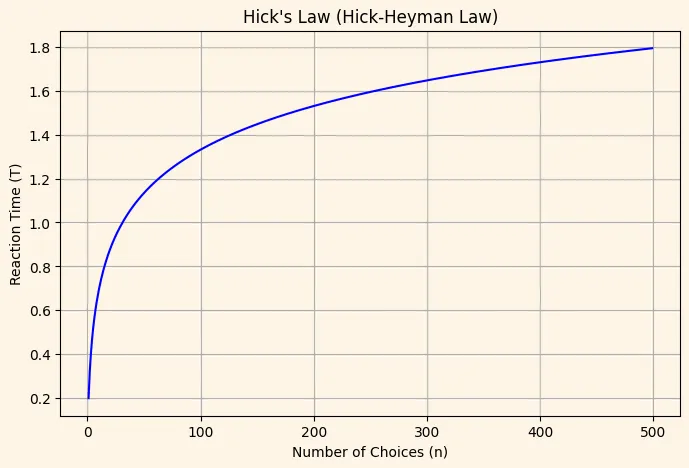
As the number of available options grows, the decision-making time increases, creating cognitive load. This is where AI agents become particularly useful, they don’t just reduce decision-making time; they eliminate the need for certain decisions altogether by automating complex workflows.
Hick’s Law and AI Agents
The key question of agent usability ultimately revolves around where an agent falls within Hick’s Law. The more decisions and functions an agent manages within an application, the greater the efficiency gains. In low-function applications with limited choices, such as a basic search tool, the advantage of an agent is marginal. However, in environments where users must navigate a vast number of features, like financial modeling tools, complex CRM systems, or data analytics platforms, the potential efficiency gains become significant.
Analyzing Deep Research through this lens reveals its limitations. The agent’s functionality is constrained to four core actions: searching the web, selecting relevant documents, analyzing large volumes of text (a strength inherited from the LLM), and compiling a comprehensive report with references. While this is useful, it does not dramatically reduce decision-making complexity for users because the number of available choices is relatively small. A user could achieve similar results by manually searching, copying, and pasting content into an LLM.
In contrast, an agentic browser faces another kind of limitation. While it can be useful in automating browsing tasks, it struggles with websites that either have very few meaningful choices or, conversely, too many built-in functions. Without native integration, an agentic browser lacks the deep understanding needed to effectively utilize all the tools at its disposal, leading to inefficiencies or incorrect actions.
What these examples highlight is that current AI agents primarily showcase the strengths of LLMs, the ability to process and summarize vast amounts of information, rather than demonstrating their full potential as autonomous decision-making tools. However, even in these cases, efficiency gains are noticeable. The ability to automate multi-step research processes, collate data, and generate structured reports saves users significant time, even if the improvement is incremental.
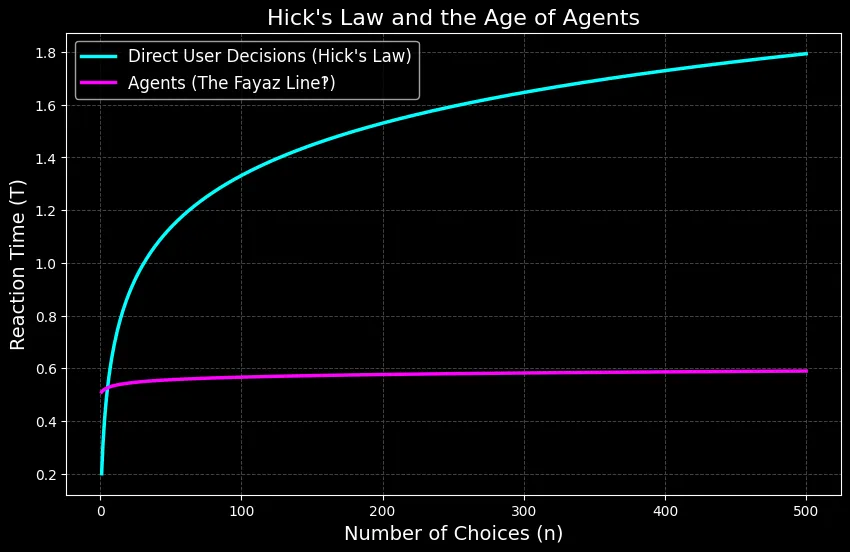
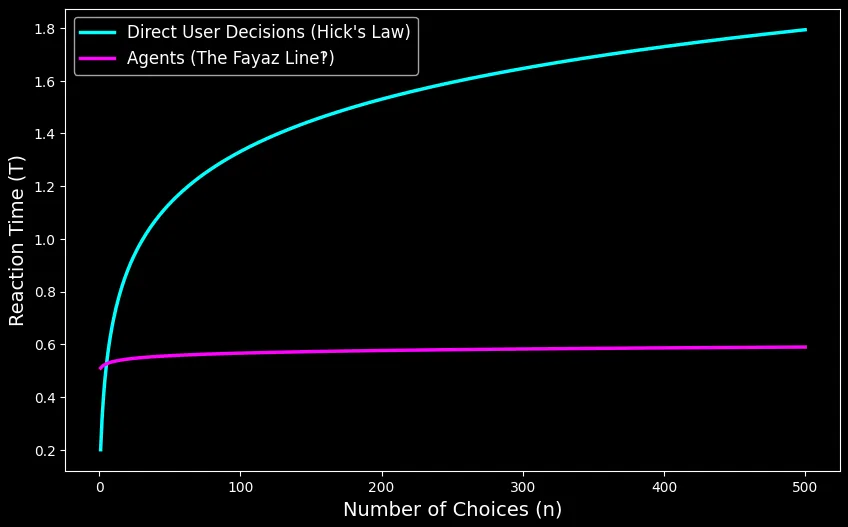
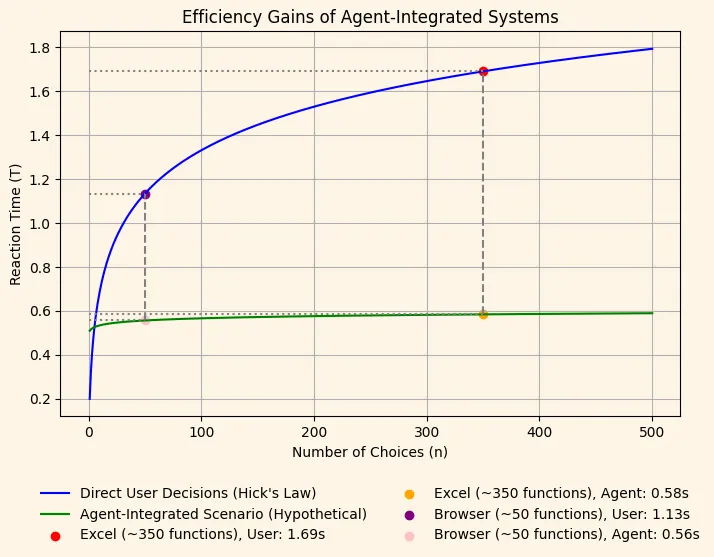
This efficiency gain becomes apparent when we consider what we can call “The Agent Line” (“some” have suggested this should be called The Fayaz Line) - the theoretical minimum reaction time when users interact with an agent-based interface. Instead of having to process and choose between multiple options themselves, users can simply express their intent to an agent, resulting in a near-constant reaction time regardless of the underlying system’s complexity. This creates a dramatic departure from Hick’s Law, where the agent-mediated interaction maintains a relatively stable response time even as the number of possible choices increases. This represents a fundamental shift in how we interact with complex systems, potentially breaking free from the logarithmic constraints of traditional human-computer interaction.
For example, consider an agent embedded within a high-function system like Excel. Excel gives users access to some 350 tools and functions. An agent that autonomously navigates formulas, optimizes data workflows, and reduces decision fatigue could drastically enhance productivity. Instead of spending time deciding between dozens of potential actions, the user can focus on outcomes while the agent determines the optimal course of action. In this way, a well-integrated AI agent doesn’t just assist—it fundamentally reshapes the efficiency of digital workflows.
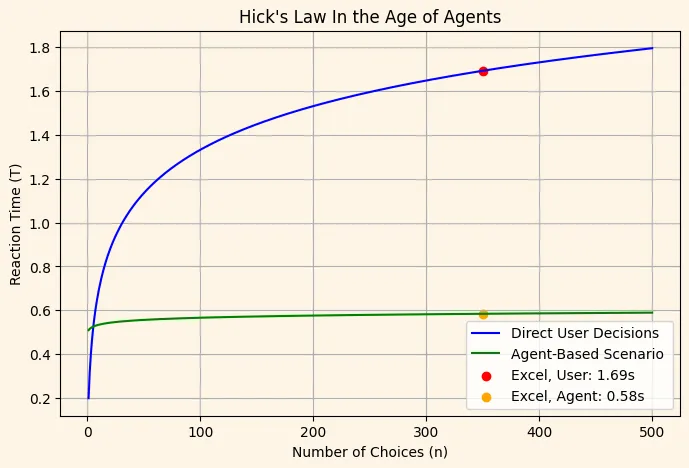
This becomes clear when looking at the difference in efficiency gains in various scenarios. As the graph illustrates, in a browser-based ticket-booking task (~50 choices), the efficiency gain with an agent is around 50%, while in Excel (~350 choices), this jumps to 65%. That is to say, that the usefulness of an agent scales with the number of choices available. In simpler tasks, the efficiency gain is notable but not transformative. However, in environments with hundreds of possible functions, such as Excel, the efficiency boost is substantial. (These estimates only reflect the time saved in deciding which function to use, not time spent reading documents in Excel or evaluating hotel options in a browser.)
The Age of Agents
Imagine scaling this effect even further—into fields like enterprise resource planning, software development, or even scientific research, where the number of potential actions grows exponentially. The more choices an agent can effectively handle, the greater the efficiency gain, making AI agents not just a convenience but a necessity in high-complexity environments.
It is thereby reasonable to say that The Age of Agents is upon us and will go far further than the simple variants that have so far reached users. Fully integrated agents in a complex system with many functions will start to emerge allowing users to maximize their efficiency and to interact with their agent as a colleague and a friend that helps them achieve great things, further accelerating the rate of progress. One question has lingered in my mind while thinking and reading about agents in the past weeks however, If agents gain more agency, will we lose ours? I, for one, am eager see!