
Will the Builders Come? (and Stay?)
Whether no code platforms will create a generation of builders or just weekend experiments
By
In the past year, a new generation of no‑code “builder” platforms has shrunken the distance between an idea and a working product to seconds. With little more than natural‑language prompts and a browser, one can spin up a rudimentary app in less than ten minutes. That immediacy feels magical, inspiring people who previously lacked the technical skills to turn their ideas into functioning applications. Yet as these platforms surge in popularity, new questions surface. The question is no longer can we build apps quickly, but will a broader audience start building, and, after completing their first or second project, will they continue once the novelty wears off?
What Are Builder Tools
These tools allow users to become builders rather than consumers in minutes. Platforms such as Replit, Bolt, and Lovable translate plain‑text instructions into beautiful and crisp looking webapps, allowing the user, or the builder if you may, to create by describing features and design preferences all through the lens of the frontend. This article will not focus on the exact capabilities of the language models under the hood, those evolve every few months with better coding performance and increasingly agentic behavior over large code bases, and thereby improving the coding capabilities of these systems. Nor will it discuss AI‑assisted IDEs like Cursor or GitHub Copilot that have enhanced developers. Instead, the spotlight is on the pure no‑code layer that advertises: anyone can ship an app.
Will the Builders Come?
So far, some of the main adopters have been the usual suspects: programmers, indie hackers, and tinkerers who already understand how software is stitched together.In conversations with this crowd, they describe builder platforms as vibe‑setters: perfect for whipping up a polished demo or sketching the skeleton of a new idea. Most praise the effortless frontend generation (fuzzy icon overload aside) yet agree that things unravel once serious back‑end work is required.
Part of the challenge lies deeper than technical capability. Even as AI systems improve at generating functional code, what emerges often resembles an alien architecture, optimized for machine interpretability rather than human comprehension. The resulting codebases, while perfectly functional, can become black boxes that resist debugging, extension, or maintenance by human developers. This opacity compounds with scale: a simple app might remain parsable, but as complexity grows, the gap between how humans conceptualize software architecture and how AI assembles it widens. Few teams choose to build upon these generated foundations, treating them instead as disposable prototypes.
A second, more enthusiastic cohort consists of designers and hobbyists who lack deep technical knowledge. For them, builder tools are creative amplifiers: long‑imagined app ideas finally take shape with almost no capital. Social media overflows with their small triumphs, but they too stall when robust data or business logic is required.
Outside these two circles, the public remains largely on the sidelines. I’ve watched middle‑school students assemble apps with Lovable, yet beyond hackathons, mostly organized by these toolmakers, there has so far not been a new trend or scramble to build on a daily basis.
Which loops us back to the question: will the builders come? Even if models attain near‑perfect competence, it is unclear how many people actually want to build software. It is perhaps the engineers fallacy to assume everyone is as enthusiastic about building tools as they are, as I am reminded every time I meet with friends from my high school in Sweden most of whom live a happy life, more or less oblivious to the current state of AI and relatively disinterested in building apps, as opposed to my friends from university all of whom are builders. So even if these models become perfect in building it is still uncertain if everyone wants to build!
Complexity Creeps In
Earlier I noted a persistent limitation: most builder platforms still struggle to generate dependable back‑end architectures. At first glance that looks like a shortcoming of the underlying models, yet as their coding skill improves the real constraint reveals itself, the user’s own grasp of back‑end design and engineering principles. Language models can scaffold servers, databases, and APIs, but only to the extent that the prompts describe them precisely.
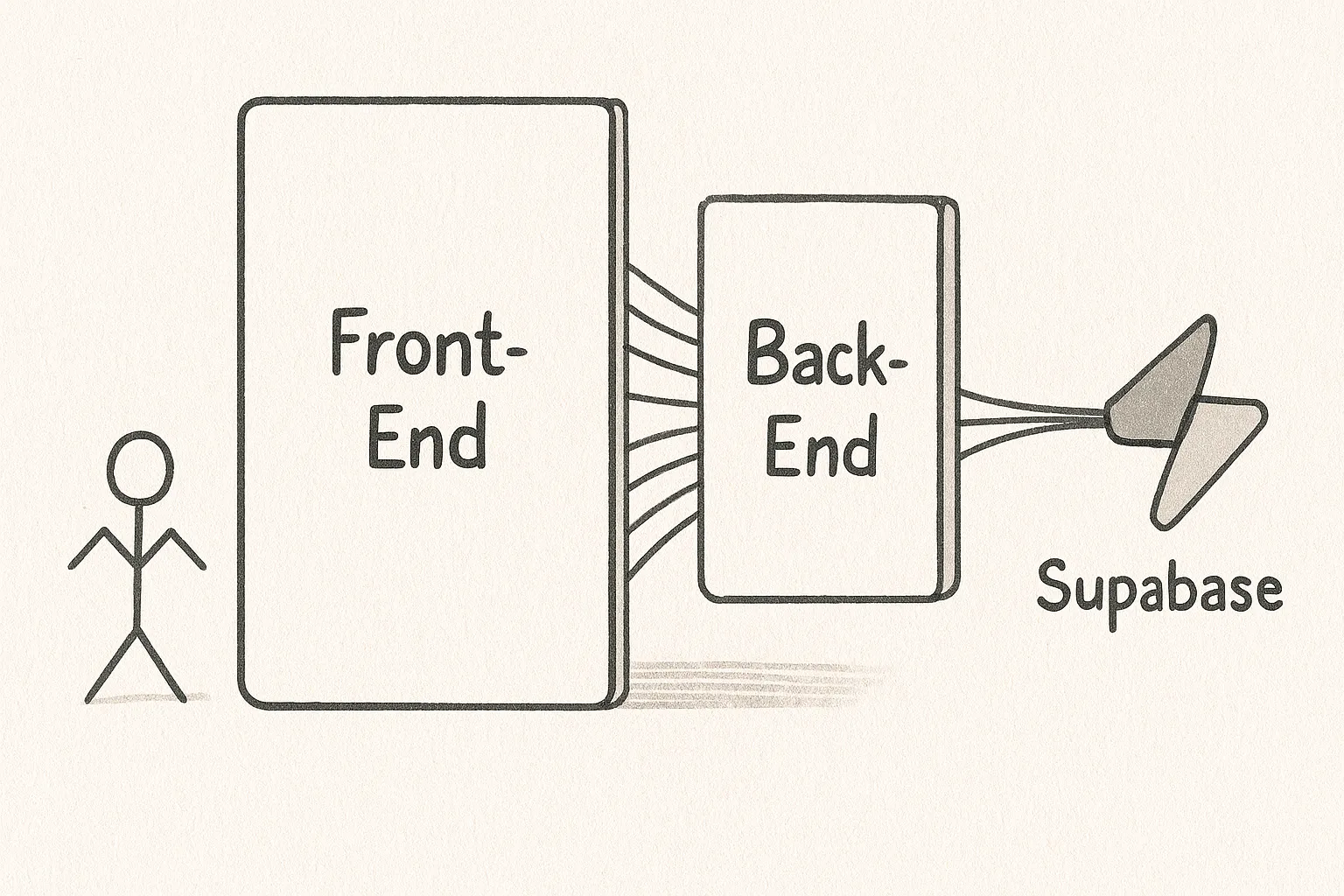
Two bottlenecks follow. The first is an engineering‑knowledge bottleneck: a non‑developer must know how to specify the back‑end they want and how to review what the model produces. This is manageable for small projects; beyond that, the cognitive load quickly balloons. The second is an alignment bottleneck: even a meticulous prompt can drift from intent because the user sees the project almost entirely through the frontend canvas. As hidden logic and complexity accumulates, the risk of misinterpretation and misalignment between what the user desires and what the models interpret as the user’s desire rises.
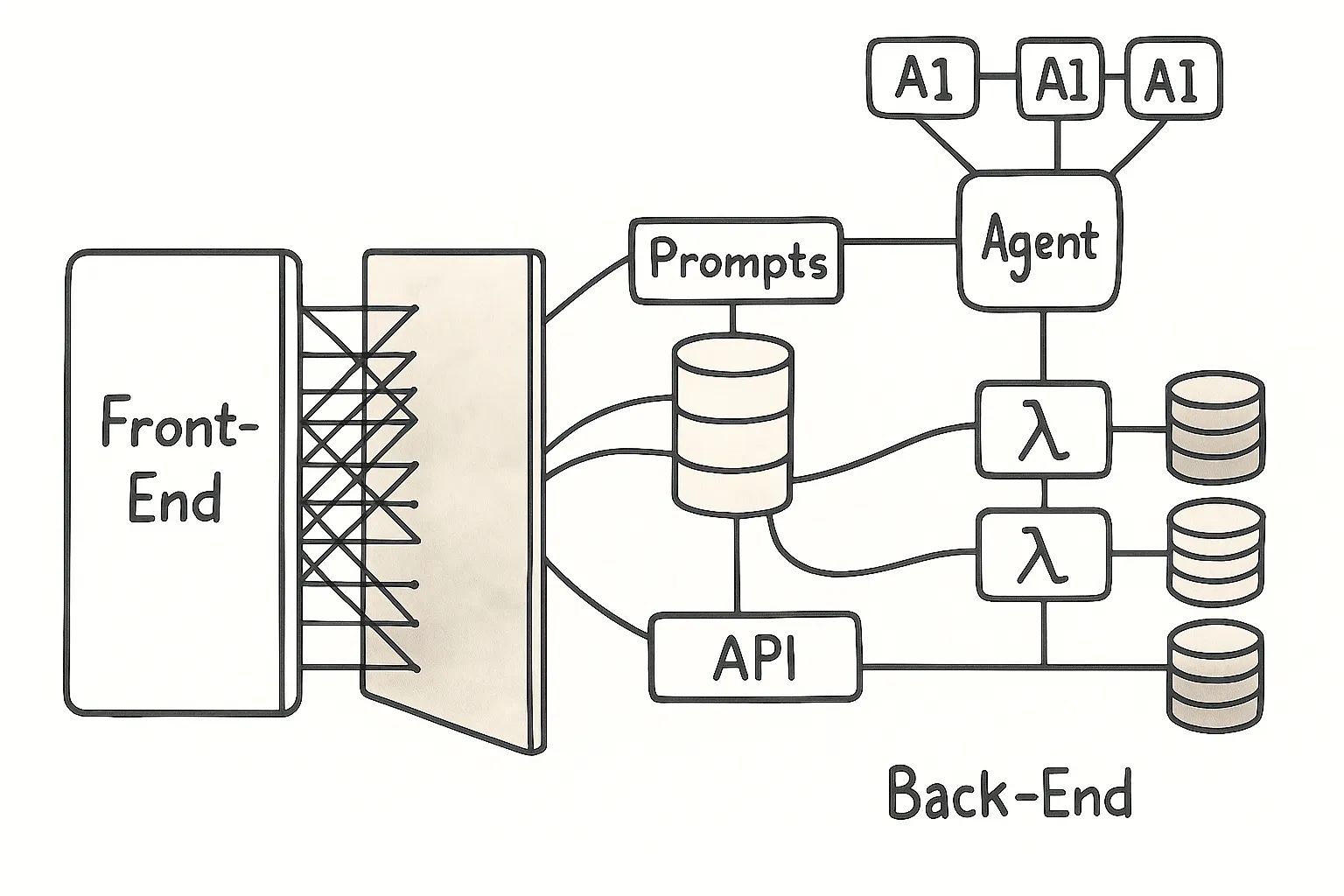
Even a meticulous and detailed prompt can drift from intent because the user sees the project almost entirely through the frontend canvas. As hidden logic and complexity accumulates, the risk of misinterpretation and misalignment between what the user desires and what the models interpret as the user’s desire rises.
Complexity therefore imposes a ceiling. You can whip up an interface that looks like TikTok, but you cannot build TikTok without understanding recommendation loops, data pipelines, and ML infrastructure. The limitation is not the model’s raw intelligence; it is the semantic gap between what a GUI can express and what a production system truly demands.
Will They Stay?
Because of that gap, many projects risk becoming one‑off weekend experiments. The platform’s convenience encourages breadth, try ten ideas in ten days, rather than depth, commit to one and nurture it. A common pattern is the one‑month churn: a small‑business owner signs up, generates a landing page, pays for a month, and cancels once the job is done. Whether builders stay hinges on how gracefully these tools expose deeper layers, data models, deployment pipelines, performance tuning, without breaking the “no‑code” contract.
This churn feeds a broader question: can the economy shift from consumption‑first to builder‑first? In the optimistic scenario, every user forges bespoke tools the moment a need surfaces, custom calendars, lightweight CRMs, niche social spaces, just as naturally as drafting an email. So far, that future has not materialised: most people still default to Apple Calendar rather than crafting their own, let alone building their own bespoke TikTok! But the aspiration sits on the horizon, awaiting usability breakthroughs and new cultural norms around everyday creation.
The Home Run
Where, then, might builder platforms truly shine? One promising area is social micro‑creation: lightweight games and utilities spun up for tight‑knit communities. Imagine remixable mini‑games passed around a Discord channel or hyper‑local tools built on a whim for a neighbourhood event, or an app for sharing family trip planning. Because the stakes are low and the scope is narrow, the risks of the alignment problem shrink; the joy comes from rapid sharing rather than perfect engineering.
Claude’s new Artifacts feature offers an early glimpse of how this might evolve. Rather than each builder platform creating isolated ecosystems, we might see model providers themselves become the universal runtime where all created apps live and are shared. This echoes the Roblox model: users build experiences within a shared platform, instantly accessible to all other users without the friction of traditional app stores. If AI providers become the de facto distribution layer, they could sidestep the App Store and Google Play gatekeepers entirely, creating a more fluid exchange of micro‑apps and experiments. The implications are profound: instead of downloading apps, users might simply invoke them through their AI assistant, blurring the line between using and building.
As foundation models continue to improve, the indie‑gaming analogy grows stronger, a flourishing long tail of niche experiences too small for a full dev team yet delightful to build and exchange. Whether that niche blossoms into a genuine “builder economy” depends not just on discovery loops and network effects, but on whether platforms can create seamless sharing mechanisms that make distribution as effortless as creation. The final question remains: will these tools make builders of us all, or simply become another tool in the box of builders?