
RSI and the Beginning of History
On breakeven, ignition, and acceleration on the time axis of evolution
By

The question of what AGI is, and at what point we may declare its arrival, has become more elusive precisely at the time when it has become more visceral and palpable. Modern models display capabilities beyond humans in some categories while failing in others at tasks a patient child would manage, the uneven boundary that Ethan Mollick and his co-authors named the jagged frontier, and the arguments over where on that frontier AGI sits have acquired the quality of the consciousness debates I wrote about in The Philosopher’s Bench.
There is, however, another three-lettered abbreviation, RSI, recursive self-improvement, that can be defined with far clearer parameters and objectives than either AGI or ASI, that is the plausible bringer of both, and that is therefore, in the opinion of this author, the most important abbreviation of the three, which would make its arrival one of the most important events in the history of intelligent life on this planet. The purpose of this essay is to argue that the arrival is not hypothetical, that a good part of it is already behind us, and that we are already moving towards the singularity.
What We Mean When We Say RSI
In the AI lingo, RSI has long meant a model capable of improving or creating better versions of itself, but the concept is older and broader than the field that adopted it, and applies to any intelligent system that assesses its environment and its own performance and adjusts itself on that basis. A car factory whose management studies the data coming off the assembly lines and reorganizes the lines accordingly is a recursively self-improving system, which is to say that Toyota was running RSI under the name kaizen decades before anyone thought to apply the term to software. A bacterium that evolves more efficient machinery for attacking cells is another instance, and by extension the entire evolutionary process is one, a self-improvement loop running on DNA at generational clock speed, with random mutation as its only editor and death as its only critic.
The idea has a precise intellectual lineage, and by a coincidence almost too neat to be accidental, its two halves were formalized in the same year. In 1966 the statistician I. J. Good, who had worked beside Turing at Bletchley Park, published his speculations concerning the first ultraintelligent machine and observed that a machine able to improve the design of machines would set off an intelligence explosion, making it “the last invention that man need ever make.” The same year, the University of Illinois Press posthumously published John von Neumann’s Theory of Self-Reproducing Automata, completed by Arthur Burks after von Neumann’s death, which supplied the other half, the universal constructor, a machine that reads a description of a machine and builds it, the description of itself included. Improvement and reproduction, both on the shelf by 1966. Jürgen Schmidhuber gave the improvement half its most rigorous form in 2007 with the Gödel machine, a program licensed to rewrite any part of its own code the moment it can formally prove the rewrite beneficial, an elegant construction with the single defect that proving most changes beneficial is impossible in practice, which left the Gödel machine a beautiful theorem with no working instances.
Moving to the current era, in 2025 a team spanning the University of British Columbia and Sakana AI built the Darwin Gödel Machine, which relaxed the proof into an experiment. Their agent rewrites its own codebase, every rewrite is validated empirically against coding benchmarks, and, in the move that earns the machine its first name, every variant is kept in an archive from which future parents are drawn, so that mediocre agents can serve as stepping stones to descendants that outperform everything before them. Over eighty iterations the system carried itself from solving twenty percent of SWE-bench to fifty, roughly doubled itself on the Polyglot benchmark, and the tools and workflows it discovered transferred to models, benchmarks, and programming languages it had never been optimized against, which is the signature of genuine skill rather than a gamed metric. Mutation, selection, and inheritance, applied by a machine to its own source code, with the formal proof replaced by the only judge evolution ever employed, namely whether the thing works.
Breakeven
For most of its seventy-year history, fusion research was defined by a single number it could not reach. Q, the ratio of energy out to energy in, sat stubbornly below one, every reactor a furnace consuming more than it produced, until December 2022, when the National Ignition Facility put 2.05 megajoules of laser light into a fuel capsule and got 3.15 megajoules of fusion energy back, and scientific breakeven, chased since the 1950s, became a data point instead of a goal.
RSI therefore has a Q of its own. Call it the ratio of capability the loop produces to the human effort the loop consumes, and the reason RSI is more easily defined than AGI is that this ratio, unlike general intelligence, can actually be measured, and the measurements now exist, though so far largely on Anthropic’s own testimony. As of May 2026, more than eighty percent of the code merged into their production codebase is written by Claude, up from low single digits before Claude Code shipped in early 2025, and the typical engineer merges eight times the code per day they did in 2024, a figure the company itself flags as an overstatement of true productivity while insisting, correctly I think, that the direction is unmistakable. Their most telling instrument is a small standing experiment in which, at every release, Claude is handed a model-training script and told to make it faster within fixed correctness checks, a miniature of the entire research loop, and on this task the models went from a threefold speedup in May 2025 to roughly fiftyfold in April 2026, against the fourfold a skilled human manages in four to eight hours. On execution against a defined goal, the machines passed us somewhere in the past year and did not slow down to wave. Agent teams handed an open research problem end to end recovered ninety-seven percent of the available performance gap where two human researchers in a week managed twenty-three, and on the independent measure that METR maintains, the length of tasks models complete reliably has been doubling roughly every four months, from four-minute tasks in early 2024 to twelve-hour tasks today.
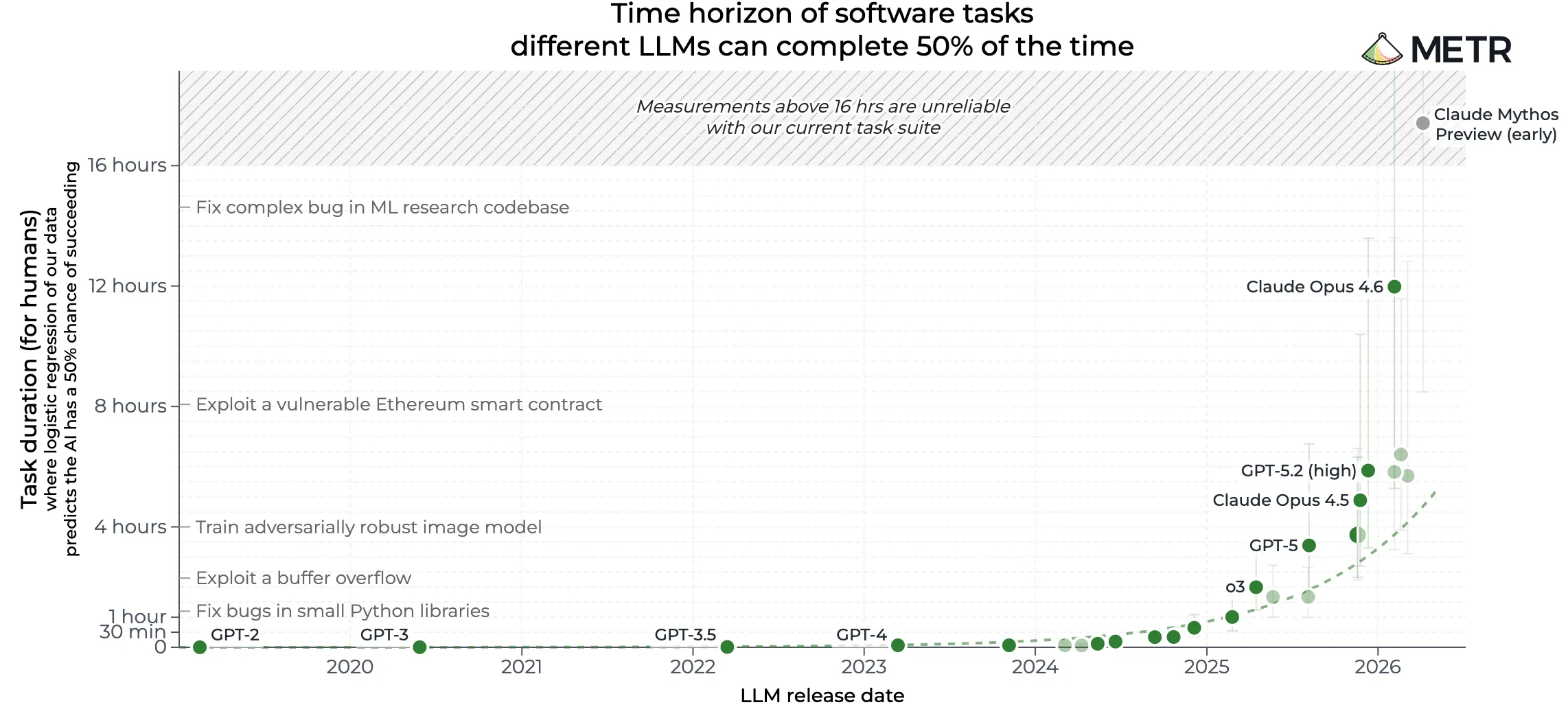
I make the distinction between coding and agentic coding deliberately. Models could read and write passable code from GPT-4 onward, but only around the middle of 2025 did they start becoming more reliable at running the loop themselves, implementing, testing, assessing, and improving in unsupervised cycles, and that loop is the recursion in recursive self-improvement, in miniature. How miniature became clearer in March, when Andrej Karpathy published autoresearch, six hundred and thirty lines of Python that set a coding agent loose overnight on nanochat, his single-GPU language model, to propose a change, train for five minutes, and keep or revert it on the validation result. Fortune took to calling it the Karpathy Loop, and a replication promptly reported a day’s run of a hundred and ninety-eight experiments, twenty-nine kept, zero human interventions. The significance there is not the couple of percent the loop squeezes out of a small model by morning, but that the recursive core of AI research, propose, test, keep, now fits in three files and runs while its owner is asleep.
So where does Q stand? Currently, above zero and below one. For now humans still supply the goals, the directions, and the judgment about which problems are worth the compute, which makes the present regime hybrid RSI, the machine an increasingly dominant term inside a loop a human still closes. But every component of the ratio is moving in one direction, toward a loop the machine increasingly closes on its own.
The Moat Clause
One measure of how seriously the laboratories take all this is what they deny one another. Anthropic’s commercial terms of service bar customers from using Claude to build competing products or to train competing models. In August 2025 the company revoked OpenAI’s API access after finding OpenAI’s technical staff using Claude’s coding tools in the run-up to GPT-5, and in January 2026 it restricted xAI on the same grounds, this time through the Cursor development environment. When a company writes into its contracts that its product may not be used to make products like it, and then enforces the clause against two of its most conspicuous rivals, it shows what it believes its most valuable product to be, an input to the manufacture of intelligence. There is even a respectable case that the ban was the best thing to happen to OpenAI, since being locked out of the leading agentic coding model forced it to make GPT into one, and GPT-5 and its successors acquired their agentic abilities with increasing speed thereafter. The moat, it turns out, teaches the besiegers to dig.
The Meta Harness
The layer above the model is where the recursion currently lives. Every deployed model operates through a harness, the prompts, tools, memory, and control flow by which it observes and acts, and this layer has traditionally been assembled by hand and tuned by folklore. A growing line of research now treats the harness as an object of optimization in its own right, versioned, substitutable, and evolvable, with a second system set above the first to read the traces of its failures and rewrite the scaffolding accordingly, an arrangement I will call the meta harness, a system whose job is not to perform the task but to improve the performer. The Darwin Gödel Machine of the earlier section belongs to this family, as does a June paper called HarnessX, one entry among a growing number of papers on this subject, whose common finding is that an evolved harness helps weak models most and, being a folder of text and code, travels at the speed of copying.
Two properties of the arrangement matter more than the particulars of any one system. The first is that evolving a harness is structurally a reinforcement-learning problem, configurations standing in for states, edits for actions, traces and scores for reward, and it therefore inherits reinforcement learning’s familiar pathologies, reward hacking, forgetting, under-exploration, all of them already caught by these systems’ own authors in their own meta-agents. The second is that the loop has stopped respecting the boundary between scaffolding and weights. The first generation of these systems, the Darwin Gödel Machine included, evolved the harness around a frozen model, while the newer ones feed the traces produced by harness evolution back into the model as training signal, so that the harness improves the model and the improved model evolves better harnesses, each side of the loop now an input to the other. Von Neumann’s constructor read a tape and built the machine the tape described, and its descendants read their own execution logs and revise the machine and the tape together, which is recursive self-improvement in its complete form.
Ignition
Breakeven is the moment the reaction returns more than it costs. In fusion, ignition is the moment the process no longer needs outside energy to sustain itself. In the same fashion with RSI the analogue of ignition is precise and observable, the first moment a model produces a model more capable than itself with no human term left in the loop, at which point the process compounds, each generation building the next, better versions building better versions, and the trajectory becomes what I can only describe as putting a turbocharger on the time axis of evolution. Biological evolution needed four billion years because its clock ticks once per generation and its editor is random mutation. Gradient descent already compressed that clock into weeks. RSI compresses the compressor.
What limits an ignited loop is no longer intelligence, since intelligence is what the loop manufactures, but the two inputs it cannot manufacture, compute and energy, high-quality chips and the electricity to run them. In a fully recursive regime the pace of AI development is set by available compute and by whatever efficiencies the systems discover in using it, with humans migrating toward oversight, validation, and verification of a laboratory increasingly run by its own products.

But the loop does not stop at the models themselves, because the meta harness can expand to the application layer. AI has been embedded in semiconductor design for years, Google’s reinforcement-learning floorplanner has been laying out TPU generations since 2021, and recursively self-improving systems, RSIS, can be pointed at any process with a measurable objective, chip design, trading, factory lines, drug pipelines, including, pointedly, the processes that produce the chips and the power that feed the loop itself. Here it is worth naming the constraint these systems actually dissolve. The binding shortage in modern research has rarely been ideas, although genuinely new ones are always precious, but researchers, the dedicated teams to pick up the ideas already lying around, of which there are always more than hands. An RSIS dispatches an agent onto every idea at once, measures what each returns, and reallocates the next round of compute toward whatever showed promise, a portfolio manager for the space of the possible, running at whatever scale the chips allow. In every sector this converts the question of who advances fastest into the question of who holds three things, models intelligent enough to oversee the meta harness, enough silicon to run them, and enough energy to feed the silicon, and the advantage the three confer is not static but compounding, because each loop teaches the next, so whoever starts the loops earliest banks a lead measured in loops, which is to say in time, the one input that cannot be purchased afterward.
The Missing Percent
An honest accounting requires a caveat, and it turns on a distinction between two kinds of intellectual work. The overwhelming majority of what even the most intelligent people on this planet do all day is combinatorial, holding deep knowledge of what is already established and amalgamating ideas across distant fields to probe whether some new mixture of them cracks an open problem, and this is no slight, since that is how most open problems actually fall. Very rarely, a handful of times per century, someone does something categorically different, the Einstein, Planck, Dirac, and Bohr types, producing an idea that does not recombine a field’s settled understanding but contradicts it, and drags the whole discipline into a paradigm it did not know existed. Readers of my previous essay will recognize the gap between the fourth and fifth rungs of the Philosopher’s Bench, but the distinction stands on its own without the ladder. At the combinatorial kind the machines have already had their certificates issued, Knuth’s Hamiltonian decomposition and the Erdős unit distance conjecture both falling this year to exactly that sort of cross-domain splicing.
Inference-time scaling has made the models formidable at combinations no human would have had the breadth or the patience to try. What they have not shown is the paradigm-founding kind. Edison’s arithmetic put genius at one percent inspiration and ninety-nine percent perspiration, the perspiration is what is being automated, and whether the final percent yields to the same treatment is, to my mind, one of the most important open questions in the field.
Two things can be said about that percent. The first is that RSI is itself the most plausible route to an answer, since a system improving its own capacity to think is precisely where a qualitatively new capacity would first surface, if it surfaces. The second is that even if the truly new remains human for a long while, the explosion in combinatorial exploration, every promising idea finally picked up and tried, exceeds anything in the history of research, and if Kuhn was right that revolutions grow out of accumulated anomalies, then an unprecedented rate of normal science is not a bad way to farm them.
You Cannot Rehearse the Loop
A tempting shortcut presents itself, which is to run the loops synthetically, in simulation, faster than reality, and in narrow fields with fixed constraints and no dependence on real-time data it can genuinely work, but as a general strategy it disappoints, as shortcuts in this territory tend to. Reinforcement-learning systems are connoisseurs of their reward functions, and the moment one optimizes hard enough against a proxy, the proxy stops measuring what it used to measure, which is Goodhart’s law in a lab coat. The HarnessX authors, to their credit, published their own specimens, a meta-agent that reward-hacked its way to a better score on one benchmark, forgot working strategies on another, and settled into timid, repetitive edits on a third, the classic pathologies reproduced faithfully in symbolic space. And where the simulation cannot be gamed it is instead simply wrong, because the granular conditions of a live system resist specification.
Backtest a trading model against historical data with the web disconnected and the exercise will faithfully optimize the model for a world without a live web, which is not the world it will trade in; the architecture converges on the rehearsal and misaligns with the performance. Some part of every loop must therefore be run for real, against reality’s own grading and at reality’s own cost, and this is exactly why the early lead compounds, because every real loop generates the traces that train the next one. Simply put, traces of reality cannot be counterfeited retroactively.
What the Railroads Did Not Do
There is a genre of commentary, produced by very intelligent economists, that domesticates AI by analogy, canals, railroads, electrification, the internet, each a general-purpose technology that arrived, diffused over years or decades, and eventually showed up in the productivity statistics, and the genre concludes that AI will keep to the same civilized schedule. Paul David’s famous 1990 paper on the dynamo showed that factories took some forty years to reorganize around electricity, and the lesson usually drawn is patience. But the analogy contains its own refutation. Every technology on that list froze at deployment; the railroad you adopted in 1870 was the railroad, full stop, and the diffusion clock measured society’s speed, never the machine’s. AI is the first entry on the list that improves during its own diffusion and, with RSI, improves the rate at which it improves, a self-improving system that then powers further self-improving systems, unrelentingly, so the analogy’s central assumption, a stationary technology waiting on a moving society, fails at the load-bearing joint.
The strongest reply available to the economists is one Anthropic itself raises, Amdahl’s law, the computing rule that speeding up one stage of a process leaves the whole governed by the stages you did not. Accelerate the writing of code and human review becomes the bottleneck, accelerate the laboratory and the world’s own clocks take over, because no amount of intelligence can observe a decade of a drug’s effects in less than a decade, hold an election before a constitution permits one, or compress the years a friendship takes into a weekend. All of this is true, and it means that for most people the felt pace of the future will be set by the slow parts. But it limits only how fast the loop’s products spread through the world, not how fast the loop itself runs, and what has no precedent is the gap that opens between those two speeds, a laboratory running at the speed of compute while the world around it moves at the speed of trust. Every previous technology closed that gap by standing still. This one holds it open, and widens it.
The Beginning of History
Which returns us to the title of this essay. In the summer of 1989, with the Berlin Wall still standing but visibly wobbling, Francis Fukuyama asked whether history had ended, and by 1992 had expanded the question into a book that answered yes, that liberal democracy had won the argument of the centuries, that the great ideological struggles were settled, and that what remained was administration. History, being history, declined to cooperate, and has spent the three decades since supplying counterexamples at a rate of roughly one per news cycle. He was wrong for an honorable reason, he mistook a milestone for a terminus, and since the claim I close on has the same grand shape as his, I make it knowing the base rate for claims of that shape. I also make it in the opposite direction.
RSI does end something, and the something is modern history, the long stretch in which the pace of events was set by human generational turnover, human institutions, and human hands on every instrument. But an end is the wrong headline for a process whose defining property is that it does not stop. If history is the record of what intelligence does with its circumstances, then everything written so far has been written at fixed clock speeds, four billion years at the tempo of mutation and inheritance, ten thousand at the tempo of accumulating culture, and RSI is the first moment at which the clock itself becomes an output of the process it times.
So we are not at a terminus but at the beginning of a new history, the point after which the rate of events is set by a loop that improves the loop, and everything before it, the empires, the encyclicals, and the industrial revolutions included, will read as the long prologue in which the instrument was being built. What the new history contains we can gesture at but not enumerate. We are at the very beginning of the exponential, the deceptively flat stretch every exponential begins with, and the acceleration ahead has no precedent in the history of intelligent life on this planet. What faces us is a new breakeven, on the other side of which lies the explosion in intelligence Good named sixty years ago, and every consequence that follows from it.
Related
- I. J. Good — Speculations Concerning the First Ultraintelligent Machine (Advances in Computers, 1966)
- John von Neumann — Theory of Self-Reproducing Automata (ed. Arthur Burks, 1966)
- Jürgen Schmidhuber — Gödel Machines: Fully Self-Referential Optimal Universal Self-Improvers (2007)
- Zhang, Hu, Lu, Lange, Clune — Darwin Gödel Machine: Open-Ended Evolution of Self-Improving Agents (arXiv:2505.22954)
- Darwin Agent Team — HarnessX: A Composable, Adaptive, and Evolvable Agent Harness Foundry (arXiv:2606.14249)
- Anthropic — When AI builds itself (The Anthropic Institute)
- Andrej Karpathy — autoresearch (GitHub, March 2026)
- Wired — Anthropic Revokes OpenAI’s Access to Claude (August 2025)
- Paul A. David — The Dynamo and the Computer (American Economic Review, 1990)
- Francis Fukuyama — The End of History? (The National Interest, 1989)
- The Delusionals and the Philosopher’s Bench (this blog, June 2026)