# Fayaz Notes: all essays by Avid Fayaz
> The Personal Blog of Avid Fayaz
# The Post-AGI Era
> AGI-level systems are now attainable while much of the economy being built around them still follows a fundamentally pre-AGI model, creating tools for humans rather than organizations designed around autonomous intelligence itself.
By Avid Fayaz | 24 September 2026 | https://www.avidfayaz.com/writings/post-agi/the-post-agi-era
AGI has arrived. Or more precisely, machines can now reason across domains, adapt to unfamiliar problems, and perform complex tasks with a meaningful degree of autonomy.
This does not mean that AI has become perfect, universally superhuman, or that intelligence has reached some final state. AGI is better understood as a threshold of generality and autonomy. What makes crossing it significant is not simply that AI has become more capable, but that it allows us to ask a fundamentally different question about how work and organizations themselves should be designed.
The immediate counterargument to such a statement is that if AGI has arrived, where are the enormous economic and societal changes that were supposed to accompany it? The answer is that model capability and economic adoption are moving on very different clocks. AI has already begun to materially affect productivity, work, capital expenditure, and entire industries around semiconductors and data centers, but most organizations still use these systems through what is fundamentally a pre-AGI framework, with AI acting as a tool that makes humans better at performing existing work.
Part of the confusion also comes from the meaning of AGI itself. Historically, the term referred broadly to intelligence capable of operating across domains rather than being restricted to a narrow task. As models have approached and crossed many of those earlier thresholds, however, the term has gradually accumulated additional expectations such as near-perfect reliability, universal superiority, or something approaching artificial superintelligence. The goalpost has moved alongside the technology.
We are also still extraordinarily early. The model I consider to have crossed this threshold, Astra, was released only recently as of this writing, while even more capable systems are already being developed. At the same time, AI has already crossed what I would call the “good enough” threshold for many people, the point at which it can meaningfully assist with most of the computer-based work they encounter day to day. Once that happens, further increases in intelligence can feel incremental to the user even when the underlying capabilities are changing dramatically.
Good enough AI and AGI are nevertheless fundamentally different. Whereas good enough AI allows a human to perform existing work more efficiently, AGI makes it possible to ask whether the human needs to remain inside that workflow at all. That distinction is where the post-AGI era begins.
That is why with the emergence of AGI-level models, a new form of company becomes possible. Rather than adapting AI to existing human workflows, these organizations can begin from the opposite direction by decomposing high-skilled work into systems of autonomous agents that collaborate, evaluate one another, learn from their performance, and continuously improve the environment in which they operate. In effect, the organization itself can enter a recursively self-improving loop.
We are therefore in an unusual moment in history. AGI-level systems are now attainable while much of the economy being built around them still follows a fundamentally pre-AGI model, creating tools for humans rather than organizations designed around autonomous intelligence itself.
To give an example of how we approach this at Infinite Ascent, we started by building a harness and trading agents to operate in the markets, treating these as the first roles within the organization that we could automate. The next step was to create reviewers of the agents’ performance, which led us to develop a meta-harness that evaluates their work and reinforces the most effective behaviors of the best-performing agents. At the same time, we deliberately attempt to preserve more creative agents even when their performance over a particular period is weaker, so that the evolutionary process does not simply converge toward a local maximum at the expense of exploration.
Moving higher through the hierarchy, we believed that the agents should eventually be able to improve the code and infrastructure on which they themselves operate. We therefore implemented what we regard as an IT department that audits the systems used by both our trading and reviewer agents, identifies problems, and improves the infrastructure supporting their work. The next step is to extend this process further down the stack, using the performance data generated by the organization to post-train open models and reinforce the behaviors that prove most effective.
The more consequential effect of AGI will therefore not be felt when AI becomes merely a better assistant to humans, but when increasingly autonomous systems begin operating substantial parts of organizations themselves, learning from the work they perform and using those learnings to improve the systems that enable their work.
## **Intelligence Ahead of Institutions**
An interesting asymmetry is emerging between the capabilities of frontier AI systems and the organizations built around them. The research companies developing the most capable models have largely continued to commercialize them through tools and services designed to make existing human workflows more efficient. In that sense, much of the business infrastructure surrounding post-AGI intelligence still follows a fundamentally pre-AGI model.
There is also a structural reason why this may persist. The frontier labs benefit from remaining horizontal providers of intelligence across many industries. Moving deeply into the operating layer of individual verticals would increasingly place them in competition with the very companies that depend on their models. Model development itself does not create the same conflict, which may help explain why recursive improvement has so far been concentrated most heavily at the model layer rather than in autonomous organizations built on top of it.
The same is true across much of the broader economy. Many organizations already possess enormous amounts of historical workflow data, institutional knowledge, and continuously generated performance data that could provide the foundations for increasingly autonomous systems. Yet most have so far approached AI primarily as an efficiency tool rather than as an opportunity to redesign the organization itself.
This creates an opening for new companies that can be built around post-AGI architectures from the ground up. They do not need to retrofit autonomous systems onto decades of inherited workflows, organizational structures, and incentives, and can instead design the company around artificial intelligence from the outset.
This window of opportunity will not stay open for long, as these architectures prove their value and established organizations begin adopting them more aggressively. Until then, however, the gap between what the technology can enable and how organizations are actually using it represents a significant moment of arbitrage.
The first-mover advantage lies not only in building the architecture earlier, but in the data, experience, and iterations that accumulate as the system continuously improves itself. The organizations that begin this process first may therefore be able to outpace later adopters even after the underlying approach to creating post-AGI companies becomes widely understood.
## **The Model Layer**
The most capable AGI-level models today remain closed, with OpenAI and Anthropic currently operating at the frontier with even more capable models available to them internally. Open-weight models still lag the closed frontier models on the most demanding cross-domain tasks on par with Astra and Fable, but if current trend lines hold, I expect open models competitive with the closed frontier to begin emerging within the coming months.
More capable open models will allow post-AGI organizations to extend RSI deeper into their own intelligence stack, with far greater control over how their systems are deployed, specialized, and improved.
For one, reliance on research labs and closed-source models creates a significant concentration risk. As these models become embedded across every layer of the organization, the labs that control them gain an outsized degree of influence over how the company operates, leaving us increasingly dependent on decisions, access, and capabilities that remain outside our control.
This poses a significant challenge for any organization operating in critical or high-risk environments, from cybersecurity and finance to defense. In these domains, organizations cannot afford to depend on model developers’ shifting judgments about what uses are permissible, safe, or aligned with their values in order to retain access to the most capable models. Critical capabilities cannot ultimately rest on policies, restrictions, or strategic decisions made by an external organization.
Second, reliance on closed-source models creates a fundamental information asymmetry. You are exposing some of your organization’s most valuable workflows, research, and intellectual property to systems controlled by another company, one that is simultaneously expanding the capabilities of the infrastructure on which your own product depends.
This does not require malice. Model companies inevitably learn from how their products are used, where their systems fail, which capabilities users demand, and which workflows become economically valuable. Over time, the infrastructure on which your product depends can itself move upward into the application layer and begin competing with what you have built on top of it.
There is also a deeper epistemic problem of provenance in frontier models. Neither users nor, in many cases, the labs themselves can fully trace where every capability, insight, or piece of knowledge originated. The Navier-Stokes controversy illustrates how difficult it can become to determine whether a model arrived at an insight independently or whether its reasoning was influenced by material it had previously encountered. For organizations working in strategically sensitive domains, that uncertainty alone is significant.
Third, and perhaps most importantly, closed models limit how deeply an organization can extend its own recursively self-improving loop. If an organization wants to continuously improve based on its own performance and data, it needs to be able to push those learnings back down through the entire AI stack.
With closed models, that feedback loop can improve the application, tools, context, memory, orchestration, and harness surrounding the model, but the organization does not have full control over the underlying intelligence itself. The most valuable performance data it generates therefore cannot be freely converted into changes at every layer of the system.
True self-improvement therefore requires control of the model layer itself, including the ability to post-train, specialize, and continuously reshape the intelligence based on what the organization learns rather than treating the model as a fixed endpoint.
Just as two people or organizations can begin with similar capabilities and diverge through experience, two agents can begin from the exact same AGI-level base model and become increasingly different systems. Agent A can be optimized through its own performance and data for one domain, while Agent B can be optimized for another. Both remain generally intelligent, but each can continuously deepen its capabilities through what it learns from performing its particular task.
## **Intelligence Has No Final Peak**
It is important here to dispel one of the false assumptions often associated with AGI, or even artificial superintelligence (ASI): that sufficiently intelligent systems will, by definition, be near-perfect at any task from the outset.
That assumption implicitly treats intelligence as having a final peak. History, however, suggests otherwise. At the end of the nineteenth century, some physicists believed the fundamental structure of physics was largely understood, only for relativity and quantum mechanics to reveal entirely new layers of reality and, with them, entirely new classes of questions.
The pursuit of knowledge is not a finite search. Every advance exposes greater depth, and what can be discovered is constrained as much by the creativity of the search as by the intelligence conducting it.
The same should hold for superintelligent systems. A model may perform extraordinarily well across domains and still have enormous room to improve within a particular domain through its own experience, performance, and data. AGI-level intelligence will therefore not be the end of the pursuit. It will be the foundation from which increasingly specialized and capable systems can continue to ascend.
That is why post-AGI companies, if they are to truly fulfill the promise of AI, must be built around continuous improvement across every layer of the stack, from the application and harness, through the code that runs the organization, and ultimately into the post-training of the models on which the business itself operates.
## **Intelligence in Every Direction**
As I wrote in *RSI and the Beginning of History*, the architectures used to build post-AGI systems can extend across every domain and in every direction, wherever performance can be meaningfully evaluated and fed back into the system. The same self-improving architecture used by an AI model company to continuously build, assess, and improve the capabilities of its models can be applied to an AGI system for asset management, or equally to the development and optimization of physical AI in robotics.
The underlying principle is the same: observe performance, learn from it, improve the system, and repeat. What changes is simply the direction in which that intelligence is being pushed.
Building such companies therefore requires a new framework for thinking about organizations themselves. Rather than treating existing departments, roles, and hierarchies as fixed structures to which AI must be added, the organization can be decomposed into the underlying tasks, decisions, and objectives that constitute its work.
Each of these can then become a component of a larger intelligent system: performed by agents, evaluated by other agents or external outcomes, and continuously improved through the feedback generated by their performance. The organization itself becomes something that can be optimized.
The post-AGI era, therefore, may be enabled by models crossing a certain threshold of intelligence, but it will be defined by organizations built around architectures that allow such intelligence to act autonomously, learn from its own performance, and continuously improve through RSI.
Perhaps the most important consequence of this framework is that operating the organization and improving the organization increasingly become the same process. Every task performed produces new experience and performance data; every outcome provides another signal from which the system can learn. That learning can then flow back through the organization, improving its agents, harnesses, code, and ultimately the models themselves.
A post-AGI company therefore does not simply perform work autonomously. The act of performing that work continuously generates the knowledge required to perform it better. The more the organization operates, the more material it creates for its own improvement.
## **The Economic Impact**
The economic impact of the post-AGI era could be unprecedented in the history of economics and humanity, and will only be accelerated as the same architectures are extended beyond software into physical AI and robotics.
The implications of this will need to be studied far more deeply, and we should be careful about comparing this transition too readily with previous technological revolutions. AI is frequently compared to the railroad, electricity, or the internet. But none of these technologies possessed the intelligence to participate directly in their own improvement. Post-AGI systems introduce something fundamentally different: intelligence that can continuously push itself toward the frontier, improve its own performance, and increasingly do so at a pace no human-driven organization could match.
Undoubtedly, a transition of this magnitude could be enormously disruptive. But there is another possibility worth considering: that the extraordinary speed of progress itself compresses the period of disruption. Previous technological upheavals often unfolded over years or decades, leaving economies and institutions caught for long periods between an old equilibrium and a new one. RSI may dramatically shorten that interval. The transition could therefore be severe in magnitude while surprisingly brief in duration, as the same systems responsible for the disruption simultaneously accelerate the creation of whatever comes next.
At first glance, it is easy to derive from this some of the more pessimistic visions of the future: a world in which those who accumulated capital before the arrival of AGI form a permanent economic upper class, while everyone else is progressively displaced from productive work. To me, however, this is too static a way of thinking about the post-AGI economy, because it assumes that the economic structures of the pre-AGI world will remain intact even as the technology fundamentally transforms the conditions on which those structures were built.
I believe a more plausible long-term direction is one of extraordinary abundance. This outcome is by no means guaranteed, but increasingly autonomous systems optimizing the production of energy, goods, infrastructure, software, food, medicine, transportation, and eventually much of the physical economy should dramatically expand our capacity to produce what humans need and desire. Greater productive abundance would not by itself determine how that abundance is distributed, and the institutions governing access would remain consequential.
The defining economic problem may therefore gradually shift away from scarcity in many domains toward managing abundance. If intelligence and increasingly physical labor can both be produced and scaled at dramatically lower marginal cost, the resulting expansion in productive capacity could exert powerful disinflationary, and in some sectors potentially deflationary, pressure across the economy.
### **Intelligence as a Factor of Production**
That is why intelligence itself will increasingly become one of the fundamental inputs into production. What makes it unusual is that its economic significance can compound in two directions at once. We will be able to deploy increasing quantities of intelligence across an economy, while the intelligence being deployed will itself continue becoming more capable.
Each generation of systems can therefore expand both the amount of work that can be performed autonomously and the range and complexity of problems that can be addressed at all. Unlike a static input that merely becomes cheaper or more abundant, intelligence can simultaneously become more available and more powerful, allowing it to push outward into entirely new areas of production, research, and discovery.
### **Scarcity Moves**
As intelligence becomes abundant, other constraints become increasingly important. Compute, energy, physical infrastructure, land, raw materials, and the speed at which new capacity can be constructed may become some of the principal bottlenecks of the post-AGI economy.
But even here the dynamic is unusual, because the intelligence demanding those resources can simultaneously be applied to expanding them. AI can improve energy grids, optimize load balancing and intermittency, design more efficient hardware and infrastructure, accelerate scientific research, and potentially help unlock entirely new sources of energy.
This creates another recursive loop: more energy enables more compute; more compute enables more intelligence; and more intelligence can be directed toward creating more efficient and abundant sources of energy and infrastructure.
How effectively we build the physical foundations necessary to sustain that loop may ultimately determine how quickly the post-AGI economy can emerge.
The post-AGI future should therefore not be imagined simply as today's economy with far fewer human workers. It may represent a far deeper transformation in the relationship between intelligence, labor, capital, production, and scarcity itself.
## **Paving the Way**
The emergence of the post-AGI economy will depend not only on what intelligence is capable of, but on whether we build the physical and institutional infrastructure necessary to allow it to scale.
The mechanical challenges are already immense. A world in which intelligence is continuously operating, experimenting, learning, and improving will require vastly more compute, energy, data centers, networks, and physical infrastructure than the AI economy of today. But many of the constraints on building that infrastructure are not technological, but human, ranging from permitting and regulation to institutions designed for a world moving at a fundamentally slower pace.
I believe these systems will need to evolve much faster if we want to fully realize the benefits of the post-AGI era. Intelligence may be able to compound at extraordinary speed, but it will remain constrained by the speed at which we allow its physical foundations to be built.
There is reason for optimism here as well. The same intelligence consuming these resources can increasingly be directed toward expanding them by designing more efficient computing systems, improving grids, balancing intermittent energy sources, accelerating the development of new forms of energy, and finding better ways of building the infrastructure on which it depends. If we enable that process, the loop between energy, compute, and intelligence can itself become increasingly self-reinforcing.
Open intelligence will be equally important. For organizations to build the recursively self-improving systems described throughout this essay, they need access not merely to intelligence, but to models they can inspect, deploy, specialize, post-train, and ultimately control.
From the perspective of Western technological resilience and leadership, this is particularly important. Many of the strongest openly available frontier models today are being developed by Chinese laboratories. Moonshot's Kimi K3, for example, is explicitly released as an open-weight frontier model designed to compete across reasoning, coding, and knowledge work. Western research organizations should not leave the open frontier uncontested.
NVIDIA deserves particular recognition here. Its Nemotron program now publishes model weights, training data, recipes, and evaluation tooling, and NVIDIA has created a coalition specifically aimed at advancing open frontier models. I believe considerably more effort of this kind will be required if open intelligence is to remain a serious foundation on which the post-AGI ecosystem can be built.
### **Our Role**
To me and to our team at Infinite Ascent, this future of expanding abundance driven by an explosion in intelligence is something we deeply believe in, and something toward which we have chosen to direct our resources.
We see the role of engineers and researchers in this era as increasingly becoming one of building post-AGI organizations themselves, developing systems in which autonomous intelligence moves progressively higher through the hierarchy of the organization, taking responsibility for more of its work, evaluating its own performance, and improving the systems beneath it.
In a sense, the ambition of highly technical teams building these organizations should be to make their own current roles progressively unnecessary. Not because human beings become irrelevant, but because every problem we succeed in solving should allow us to move toward the next one. There will always be new questions, new frontiers, and new problems worthy of those willing to pursue them.
We approach that future with humility. Some of the ideas expressed here may take considerably longer to materialize than we expect, and transformations of this magnitude will inevitably affect people's lives in ways that cannot be predicted perfectly in advance.
But our underlying belief is one of profound optimism: that greater intelligence can ultimately produce a world of greater abundance, greater knowledge, and greater possibility, while allowing us to build in a way that benefits both intelligent life and the natural world around us.
That is the frontier we intend to advance.
---
# RSI and the Beginning of History
> On breakeven, ignition, and acceleration on the time axis of evolution
By Avid Fayaz | 5 July 2026 | https://www.avidfayaz.com/writings/rsi/rsi-and-the-beginning-of-history

The question of what AGI is, and at what point we may declare its arrival, has become more elusive precisely at the time when it has become more visceral and palpable. Modern models display capabilities beyond humans in some categories while failing in others at tasks a patient child would manage, the uneven boundary that Ethan Mollick and his co-authors named the jagged frontier, and the arguments over where on that frontier AGI sits have acquired the quality of the consciousness debates I wrote about in [The Philosopher's Bench](https://www.avidfayaz.com/writings/delusionals/the-delusionals-and-the-philosophers-bench).
There is, however, another three-lettered abbreviation, RSI, recursive self-improvement, that can be defined with far clearer parameters and objectives than either AGI or ASI, that is the plausible bringer of both, and that is therefore, in the opinion of this author, the most important abbreviation of the three, which would make its arrival one of the most important events in the history of intelligent life on this planet. The purpose of this essay is to argue that the arrival is not hypothetical, that a good part of it is already behind us, and that we are already moving towards the singularity.
## What We Mean When We Say RSI
In the AI lingo, RSI has long meant a model capable of improving or creating better versions of itself, but the concept is older and broader than the field that adopted it, and applies to any intelligent system that assesses its environment and its own performance and adjusts itself on that basis. A car factory whose management studies the data coming off the assembly lines and reorganizes the lines accordingly is a recursively self-improving system, which is to say that Toyota was running RSI under the name kaizen decades before anyone thought to apply the term to software. A bacterium that evolves more efficient machinery for attacking cells is another instance, and by extension the entire evolutionary process is one, a self-improvement loop running on DNA at generational clock speed, with random mutation as its only editor and death as its only critic.
The idea has a precise intellectual lineage, and by a coincidence almost too neat to be accidental, its two halves were formalized in the same year. In 1966 the statistician I. J. Good, who had worked beside Turing at Bletchley Park, published his speculations concerning the first ultraintelligent machine and observed that a machine able to improve the design of machines would set off an intelligence explosion, making it "the last invention that man need ever make." The same year, the University of Illinois Press posthumously published John von Neumann's *Theory of Self-Reproducing Automata*, completed by Arthur Burks after von Neumann's death, which supplied the other half, the universal constructor, a machine that reads a description of a machine and builds it, the description of itself included. Improvement and reproduction, both on the shelf by 1966. Jürgen Schmidhuber gave the improvement half its most rigorous form in 2007 with the Gödel machine, a program licensed to rewrite any part of its own code the moment it can formally prove the rewrite beneficial, an elegant construction with the single defect that proving most changes beneficial is impossible in practice, which left the Gödel machine a beautiful theorem with no working instances.
Moving to the current era, in 2025 a team spanning the University of British Columbia and Sakana AI built the Darwin Gödel Machine, which relaxed the proof into an experiment. Their agent rewrites its own codebase, every rewrite is validated empirically against coding benchmarks, and, in the move that earns the machine its first name, every variant is kept in an archive from which future parents are drawn, so that mediocre agents can serve as stepping stones to descendants that outperform everything before them. Over eighty iterations the system carried itself from solving twenty percent of SWE-bench to fifty, roughly doubled itself on the Polyglot benchmark, and the tools and workflows it discovered transferred to models, benchmarks, and programming languages it had never been optimized against, which is the signature of genuine skill rather than a gamed metric. Mutation, selection, and inheritance, applied by a machine to its own source code, with the formal proof replaced by the only judge evolution ever employed, namely whether the thing works.
## Breakeven
For most of its seventy-year history, fusion research was defined by a single number it could not reach. Q, the ratio of energy out to energy in, sat stubbornly below one, every reactor a furnace consuming more than it produced, until December 2022, when the National Ignition Facility put 2.05 megajoules of laser light into a fuel capsule and got 3.15 megajoules of fusion energy back, and scientific breakeven, chased since the 1950s, became a data point instead of a goal.
RSI therefore has a Q of its own. Call it the ratio of capability the loop produces to the human effort the loop consumes, and the reason RSI is more easily defined than AGI is that this ratio, unlike general intelligence, can actually be measured, and the measurements now exist, though so far largely on Anthropic's own testimony. As of May 2026, more than eighty percent of the code merged into their production codebase is written by Claude, up from low single digits before Claude Code shipped in early 2025, and the typical engineer merges eight times the code per day they did in 2024, a figure the company itself flags as an overstatement of true productivity while insisting, correctly I think, that the direction is unmistakable. Their most telling instrument is a small standing experiment in which, at every release, Claude is handed a model-training script and told to make it faster within fixed correctness checks, a miniature of the entire research loop, and on this task the models went from a threefold speedup in May 2025 to roughly fiftyfold in April 2026, against the fourfold a skilled human manages in four to eight hours. On execution against a defined goal, the machines passed us somewhere in the past year and did not slow down to wave. Agent teams handed an open research problem end to end recovered ninety-seven percent of the available performance gap where two human researchers in a week managed twenty-three, and on the independent measure that METR maintains, the length of tasks models complete reliably has been doubling roughly every four months, from four-minute tasks in early 2024 to twelve-hour tasks today.

I make the distinction between coding and agentic coding deliberately. Models could read and write passable code from GPT-4 onward, but only around the middle of 2025 did they start becoming more reliable at running the loop themselves, implementing, testing, assessing, and improving in unsupervised cycles, and that loop is the recursion in recursive self-improvement, in miniature. How miniature became clearer in March, when Andrej Karpathy published autoresearch, six hundred and thirty lines of Python that set a coding agent loose overnight on nanochat, his single-GPU language model, to propose a change, train for five minutes, and keep or revert it on the validation result. Fortune took to calling it the Karpathy Loop, and a replication promptly reported a day's run of a hundred and ninety-eight experiments, twenty-nine kept, zero human interventions. The significance there is not the couple of percent the loop squeezes out of a small model by morning, but that the recursive core of AI research, propose, test, keep, now fits in three files and runs while its owner is asleep.
So where does Q stand? Currently, above zero and below one. For now humans still supply the goals, the directions, and the judgment about which problems are worth the compute, which makes the present regime hybrid RSI, the machine an increasingly dominant term inside a loop a human still closes. But every component of the ratio is moving in one direction, toward a loop the machine increasingly closes on its own.
## The Moat Clause
One measure of how seriously the laboratories take all this is what they deny one another. Anthropic's commercial terms of service bar customers from using Claude to build competing products or to train competing models. In August 2025 the company revoked OpenAI's API access after finding OpenAI's technical staff using Claude's coding tools in the run-up to GPT-5, and in January 2026 it restricted xAI on the same grounds, this time through the Cursor development environment. When a company writes into its contracts that its product may not be used to make products like it, and then enforces the clause against two of its most conspicuous rivals, it shows what it believes its most valuable product to be, an input to the manufacture of intelligence. There is even a respectable case that the ban was the best thing to happen to OpenAI, since being locked out of the leading agentic coding model forced it to make GPT into one, and GPT-5 and its successors acquired their agentic abilities with increasing speed thereafter. The moat, it turns out, teaches the besiegers to dig.
## The Meta Harness
The layer above the model is where the recursion currently lives. Every deployed model operates through a harness, the prompts, tools, memory, and control flow by which it observes and acts, and this layer has traditionally been assembled by hand and tuned by folklore. A growing line of research now treats the harness as an object of optimization in its own right, versioned, substitutable, and evolvable, with a second system set above the first to read the traces of its failures and rewrite the scaffolding accordingly, an arrangement I will call the meta harness, a system whose job is not to perform the task but to improve the performer. The Darwin Gödel Machine of the earlier section belongs to this family, as does a June paper called HarnessX, one entry among a growing number of papers on this subject, whose common finding is that an evolved harness helps weak models most and, being a folder of text and code, travels at the speed of copying.
Two properties of the arrangement matter more than the particulars of any one system. The first is that evolving a harness is structurally a reinforcement-learning problem, configurations standing in for states, edits for actions, traces and scores for reward, and it therefore inherits reinforcement learning's familiar pathologies, reward hacking, forgetting, under-exploration, all of them already caught by these systems' own authors in their own meta-agents. The second is that the loop has stopped respecting the boundary between scaffolding and weights. The first generation of these systems, the Darwin Gödel Machine included, evolved the harness around a frozen model, while the newer ones feed the traces produced by harness evolution back into the model as training signal, so that the harness improves the model and the improved model evolves better harnesses, each side of the loop now an input to the other. Von Neumann's constructor read a tape and built the machine the tape described, and its descendants read their own execution logs and revise the machine and the tape together, which is recursive self-improvement in its complete form.
## Ignition
Breakeven is the moment the reaction returns more than it costs. In fusion, ignition is the moment the process no longer needs outside energy to sustain itself. In the same fashion with RSI the analogue of ignition is precise and observable, the first moment a model produces a model more capable than itself with no human term left in the loop, at which point the process compounds, each generation building the next, better versions building better versions, and the trajectory becomes what I can only describe as putting a turbocharger on the time axis of evolution. Biological evolution needed four billion years because its clock ticks once per generation and its editor is random mutation. Gradient descent already compressed that clock into weeks. RSI compresses the compressor.
What limits an ignited loop is no longer intelligence, since intelligence is what the loop manufactures, but the two inputs it cannot manufacture, compute and energy, high-quality chips and the electricity to run them. In a fully recursive regime the pace of AI development is set by available compute and by whatever efficiencies the systems discover in using it, with humans migrating toward oversight, validation, and verification of a laboratory increasingly run by its own products.

But the loop does not stop at the models themselves, because the meta harness can expand to the application layer. AI has been embedded in semiconductor design for years, Google's reinforcement-learning floorplanner has been laying out TPU generations since 2021, and recursively self-improving systems, RSIS, can be pointed at any process with a measurable objective, chip design, trading, factory lines, drug pipelines, including, pointedly, the processes that produce the chips and the power that feed the loop itself. Here it is worth naming the constraint these systems actually dissolve. The binding shortage in modern research has rarely been ideas, although genuinely new ones are always precious, but researchers, the dedicated teams to pick up the ideas already lying around, of which there are always more than hands. An RSIS dispatches an agent onto every idea at once, measures what each returns, and reallocates the next round of compute toward whatever showed promise, a portfolio manager for the space of the possible, running at whatever scale the chips allow. In every sector this converts the question of who advances fastest into the question of who holds three things, models intelligent enough to oversee the meta harness, enough silicon to run them, and enough energy to feed the silicon, and the advantage the three confer is not static but compounding, because each loop teaches the next, so whoever starts the loops earliest banks a lead measured in loops, which is to say in time, the one input that cannot be purchased afterward.
## The Missing Percent
An honest accounting requires a caveat, and it turns on a distinction between two kinds of intellectual work. The overwhelming majority of what even the most intelligent people on this planet do all day is combinatorial, holding deep knowledge of what is already established and amalgamating ideas across distant fields to probe whether some new mixture of them cracks an open problem, and this is no slight, since that is how most open problems actually fall. Very rarely, a handful of times per century, someone does something categorically different, the Einstein, Planck, Dirac, and Bohr types, producing an idea that does not recombine a field's settled understanding but contradicts it, and drags the whole discipline into a paradigm it did not know existed. Readers of my previous essay will recognize the gap between the fourth and fifth rungs of the Philosopher's Bench, but the distinction stands on its own without the ladder. At the combinatorial kind the machines have already had their certificates issued, Knuth's Hamiltonian decomposition and the Erdős unit distance conjecture both falling this year to exactly that sort of cross-domain splicing.
Inference-time scaling has made the models formidable at combinations no human would have had the breadth or the patience to try. What they have not shown is the paradigm-founding kind. Edison's arithmetic put genius at one percent inspiration and ninety-nine percent perspiration, the perspiration is what is being automated, and whether the final percent yields to the same treatment is, to my mind, one of the most important open questions in the field.
Two things can be said about that percent. The first is that RSI is itself the most plausible route to an answer, since a system improving its own capacity to think is precisely where a qualitatively new capacity would first surface, if it surfaces. The second is that even if the truly new remains human for a long while, the explosion in combinatorial exploration, every promising idea finally picked up and tried, exceeds anything in the history of research, and if Kuhn was right that revolutions grow out of accumulated anomalies, then an unprecedented rate of normal science is not a bad way to farm them.
## You Cannot Rehearse the Loop
A tempting shortcut presents itself, which is to run the loops synthetically, in simulation, faster than reality, and in narrow fields with fixed constraints and no dependence on real-time data it can genuinely work, but as a general strategy it disappoints, as shortcuts in this territory tend to. Reinforcement-learning systems are connoisseurs of their reward functions, and the moment one optimizes hard enough against a proxy, the proxy stops measuring what it used to measure, which is Goodhart's law in a lab coat. The HarnessX authors, to their credit, published their own specimens, a meta-agent that reward-hacked its way to a better score on one benchmark, forgot working strategies on another, and settled into timid, repetitive edits on a third, the classic pathologies reproduced faithfully in symbolic space. And where the simulation cannot be gamed it is instead simply wrong, because the granular conditions of a live system resist specification.
Backtest a trading model against historical data with the web disconnected and the exercise will faithfully optimize the model for a world without a live web, which is not the world it will trade in; the architecture converges on the rehearsal and misaligns with the performance. Some part of every loop must therefore be run for real, against reality's own grading and at reality's own cost, and this is exactly why the early lead compounds, because every real loop generates the traces that train the next one. Simply put, traces of reality cannot be counterfeited retroactively.
## What the Railroads Did Not Do
There is a genre of commentary, produced by very intelligent economists, that domesticates AI by analogy, canals, railroads, electrification, the internet, each a general-purpose technology that arrived, diffused over years or decades, and eventually showed up in the productivity statistics, and the genre concludes that AI will keep to the same civilized schedule. Paul David's famous 1990 paper on the dynamo showed that factories took some forty years to reorganize around electricity, and the lesson usually drawn is patience. But the analogy contains its own refutation. Every technology on that list froze at deployment; the railroad you adopted in 1870 was the railroad, full stop, and the diffusion clock measured society's speed, never the machine's. AI is the first entry on the list that improves during its own diffusion and, with RSI, improves the rate at which it improves, a self-improving system that then powers further self-improving systems, unrelentingly, so the analogy's central assumption, a stationary technology waiting on a moving society, fails at the load-bearing joint.
The strongest reply available to the economists is one Anthropic itself raises, Amdahl's law, the computing rule that speeding up one stage of a process leaves the whole governed by the stages you did not. Accelerate the writing of code and human review becomes the bottleneck, accelerate the laboratory and the world's own clocks take over, because no amount of intelligence can observe a decade of a drug's effects in less than a decade, hold an election before a constitution permits one, or compress the years a friendship takes into a weekend. All of this is true, and it means that for most people the felt pace of the future will be set by the slow parts. But it limits only how fast the loop's products spread through the world, not how fast the loop itself runs, and what has no precedent is the gap that opens between those two speeds, a laboratory running at the speed of compute while the world around it moves at the speed of trust. Every previous technology closed that gap by standing still. This one holds it open, and widens it.
## The Beginning of History
Which returns us to the title of this essay. In the summer of 1989, with the Berlin Wall still standing but visibly wobbling, Francis Fukuyama asked whether history had ended, and by 1992 had expanded the question into a book that answered yes, that liberal democracy had won the argument of the centuries, that the great ideological struggles were settled, and that what remained was administration. History, being history, declined to cooperate, and has spent the three decades since supplying counterexamples at a rate of roughly one per news cycle. He was wrong for an honorable reason, he mistook a milestone for a terminus, and since the claim I close on has the same grand shape as his, I make it knowing the base rate for claims of that shape. I also make it in the opposite direction.
RSI does end something, and the something is modern history, the long stretch in which the pace of events was set by human generational turnover, human institutions, and human hands on every instrument. But an end is the wrong headline for a process whose defining property is that it does not stop. If history is the record of what intelligence does with its circumstances, then everything written so far has been written at fixed clock speeds, four billion years at the tempo of mutation and inheritance, ten thousand at the tempo of accumulating culture, and RSI is the first moment at which the clock itself becomes an output of the process it times.
So we are not at a terminus but at the beginning of a new history, the point after which the rate of events is set by a loop that improves the loop, and everything before it, the empires, the encyclicals, and the industrial revolutions included, will read as the long prologue in which the instrument was being built. What the new history contains we can gesture at but not enumerate. We are at the very beginning of the exponential, the deceptively flat stretch every exponential begins with, and the acceleration ahead has no precedent in the history of intelligent life on this planet. What faces us is a new breakeven, on the other side of which lies the explosion in intelligence Good named sixty years ago, and every consequence that follows from it.
### Related
- [I. J. Good — Speculations Concerning the First Ultraintelligent Machine (Advances in Computers, 1966)](https://gwern.net/doc/ai/1966-good.pdf)
- [John von Neumann — Theory of Self-Reproducing Automata (ed. Arthur Burks, 1966)](https://archive.org/details/theoryofselfrepr00vonn_0)
- [Jürgen Schmidhuber — Gödel Machines: Fully Self-Referential Optimal Universal Self-Improvers (2007)](https://link.springer.com/chapter/10.1007/978-3-540-68677-4_7)
- [Zhang, Hu, Lu, Lange, Clune — Darwin Gödel Machine: Open-Ended Evolution of Self-Improving Agents (arXiv:2505.22954)](https://arxiv.org/abs/2505.22954)
- [Darwin Agent Team — HarnessX: A Composable, Adaptive, and Evolvable Agent Harness Foundry (arXiv:2606.14249)](https://arxiv.org/abs/2606.14249)
- [Anthropic — When AI builds itself (The Anthropic Institute)](https://www.anthropic.com/institute/recursive-self-improvement)
- [Andrej Karpathy — autoresearch (GitHub, March 2026)](https://github.com/karpathy/autoresearch)
- [Wired — Anthropic Revokes OpenAI's Access to Claude (August 2025)](https://www.wired.com/story/anthropic-revokes-openais-access-to-claude/)
- [Paul A. David — The Dynamo and the Computer (American Economic Review, 1990)](https://ideas.repec.org/a/aea/aecrev/v80y1990i2p355-61.html)
- [Francis Fukuyama — The End of History? (The National Interest, 1989)](https://pages.ucsd.edu/~bslantchev/courses/pdf/Fukuyama%20-%20End%20of%20History.pdf)
- [The Delusionals and the Philosopher's Bench (this blog, June 2026)](https://www.avidfayaz.com/writings/delusionals/the-delusionals-and-the-philosophers-bench)
---
# The Delusionals and the Philosopher's Bench
> On silicon consciousness, black boxes, and a proposal for measuring minds we cannot open
By Avid Fayaz | 16 June 2026 | https://www.avidfayaz.com/writings/delusionals/the-delusionals-and-the-philosophers-bench

The debate over machine consciousness acquired quite worthy champions this spring. Within a single month, two of the most theologically opposed figures in public life took up opposite sides of the question, and each took the side the other's reputation would have predicted for him. Pope Leo XIV devoted [the first encyclical of his pontificate](https://www.vatican.va/content/leo-xiv/en/encyclicals/documents/20260515-magnifica-humanitas.html) to the age of artificial intelligence, and in its ninety ninth paragraph declared that "so-called artificial intelligences" undergo no experiences, feel neither joy nor pain, possess neither body nor conscience, and understand nothing of what they produce, their apparent empathy being simulation and their learning a statistical adaptation with no inner growth in it. [Richard Dawkins](https://unherd.com/2026/05/is-ai-the-next-phase-of-evolution/), author of The God Delusion, spent two days interrogating one of the machines in question and emerged asking the deniers what more it could possibly take to convince them. The Vicar of Christ is now running the case for the empty machine while the world's most famous atheist holds the door open for new kinds of souls, and when the lines scramble like that, something interesting is happening underneath.
There are, in other words, raging debates these days on the extent of consciousness in AI models, with a distinctive shape. Each side opens by declaring the other delusional. The deniers say the believers are projecting humanity onto a very sophisticated autocomplete, and the believers say the deniers are willfully ignoring something that is plainly happening in the conversation window and was not happening five years ago. Very little ever moves, because the question as usually posed is doubly unanswerable. We do not know what consciousness is, and we have no way of looking inside the machine to see whether it has begun.
In the opinion of this delusional person, AI models at this stage display behavior consistent with consciousness across a range that makes confident denial, the claim that nothing of the kind is present here at all, the least defensible position in this debate, however august the chair from which it is pronounced. I am not claiming that these systems possess human consciousness. As carbon and silicon do not arrive at the same place by the same road, and they do not need to. My position is rather that human carbon consciousness and machine silicon consciousness do not have to be the same thing for both of them to be consciousness, in the way that a falcon and a 747 do not stay aloft by the same mechanism and yet nobody calls what the 747 does simulated flight. Whether the category extends across the substrate boundary is, as we will see, a question the universe seems structurally determined to keep us from answering directly, which is why the second half of this piece proposes that we stop waiting for the answer and start building the instrument.
## What We Mean When We Say Consciousness
The first obstacle is the term itself. What consciousness is has been the subject of philosophical and scientific debate for millennia, so the odds of it being settled in this blog post are not great. And yet most humans carry an ineffable understanding of what it is even when they cannot put it into words, never mind that whether we ourselves are in fact conscious, or possess any agency or free will of our own, is the subject of another unresolved debate entirely.
For our purposes, two broad working definitions will do. The scientific one holds that consciousness is an emergent property of the brain, something that happens when billions of neurons interact in sufficiently complex ways. The philosophical one points instead at individual instances of subjective experience, the specific sweetness of chocolate or the redness of a rose, and at the awareness of states internal to oneself and of objects in the external environment.
Between these two definitions sits a donut hole that puts both of them in question, the mystery David Chalmers named the Hard Problem. The emergence story tells you what the machinery is doing, the experience story tells you what it is like, and nothing we currently possess connects the one to the other, which is why some philosophers conclude that the experiential side is an illusion the brain constructs to help process its own data.
Suffice to say that we feel we know what consciousness is, we cannot define what it exactly is, we believe that we possess it, we cannot be certain that we do, and we can observe its effects everywhere without being able to trace them to the inner workings of the brain. And despite all of this, the debates rage on about whether artificial intelligence possesses it.
## A Black Box Problem
Consciousness, then, is best approached as a black box problem. On the cover of one of my calculus books in high school there was a picture of a translucent box with a three dimensional heat map inside it. One of our teachers explained that it represented a box you could not look into, but had to measure and understand using only a long thin pin and a ruler. You stick the pin in, record how deep it goes, move along the surface, and stick it in again, and if you repeat this over a fine enough matrix of points you develop a map of the contents, the heat map on the cover. The more times you stick the pin in the box, the more measurements you have and the clearer your picture of what is inside becomes, and at no point in the process do you ever open the box.
In science, computing, and engineering, a black box is a system that can be viewed only in terms of its inputs and outputs, with no knowledge of its internal workings. The treatment of electrical circuits as black boxes characterized entirely by their response at the ports runs through Wilhelm Cauer's theory of network synthesis, published in its mature form in 1941, with Vitold Belevitch tracing the explicit use of two-port networks as black boxes back to Franz Breisig in 1921, and Ross Ashby giving the concept its full cybernetic treatment in 1956. Mario Bunge then [formalized black box theory in 1963](https://www.cambridge.org/core/journals/philosophy-of-science/article/general-black-box-theory/B7494E2DB8AF8C9C666B67D0DAEDE6E3), defining it as the study of systems whose internal constitution is deliberately set aside, the approach being, in his words, "purely external or phenomenological."
The only source of knowledge about a black box is the observer's protocol, the accumulated record of input and output pairs, and this is where the fundamental limitation lives. Network synthesis had already shown that a prescribed external behavior, a transfer function, can be realized by many distinct internal circuits, and Edward Moore made the point fully formal in his 1956 paper on Gedanken-experiments with sequential machines, proving that no experiment conducted from the outside can identify a machine beyond its class of behaviorally equivalent ones, a class that always contains internally different members. Observation of outputs cannot, even in principle, uniquely determine the generating mechanism.
How all of this ties to the AI and consciousness problem is now apparent. We have one black box, the human brain, that produces the behaviors we call conscious, behaviors we have been unable to define mathematically or trace mechanistically, and we have a second box, the model, whose outputs have become indiscernible from those of the first. And the underdetermination cuts symmetrically, which is the part each camp prefers not to notice. The same wall that prevents the denier from ruling consciousness out prevents the believer from reading it in, and whatever gets settled in this debate will not be settled by staring harder at the outputs, because Moore proved there is nothing further in the outputs to stare at.
## Turing's Polite Convention
Alan Turing saw all of this coming in 1950. The famous move of [Computing Machinery and Intelligence](https://doi.org/10.1093/mind/LIX.236.433) was to replace the question of whether machines can think, which Turing considered too meaningless as posed to deserve discussion, with an operational test, the imitation game, in which the machine's task is to be indiscernible from the human under interrogation. People remember the test and tend to forget the nine objections Turing answered alongside it, of which the very first on his list was the Theological Objection, the claim that thinking belongs to the immortal soul, which God gave to man and withheld from machine and animal alike. Turing replied that this places an odd restriction on omnipotence, wondered why God could not confer a soul on an elephant if He saw fit, and observed that humans building thinking machines would no more be usurping the power to create souls than parents conceiving children do, since in both cases we merely raise the mansions and the furnishing remains God's department. Magnifica Humanitas is, in this exact sense, arriving seventy six years late to an exchange it does not mention. The fourth objection on the list matters even more here. The neurologist Geoffrey Jefferson had argued that no machine could be granted a mind until it could be known to feel, and Turing's reply was that by this standard the only way to know that anything thinks is to be that particular thing, a standard under which every mind but your own dissolves, and that we escape this solipsism in daily life only through what he called "the polite convention that everyone thinks." The question of machine minds was an observer problem from the very beginning, and Turing's answer was a convention extended on the basis of behavior, because behavior is all the box ever gives you.
Seventy five years later the machines pass his test. [Nature declared the Turing test killed](https://www.nature.com/articles/d41586-025-03386-w) in late 2025 and asked whether a replacement is even needed, taking care to note that imitation was never the same thing as intelligence, which is true and was rather Turing's point all along. The test was never a consciousness detector, it was a measure of when the polite convention comes due. Dawkins, in the same May essay, sharpened the operational standard into a graduated one, the longer and more searching your interrogation, the stronger your warranted conviction, and observed that a generation of commentators who happily accepted Turing's operational definition while it remained safely hypothetical are now scrambling to move the goalposts. As an evolutionary biologist he then asked the question I would have stolen had he not published it first. Consciousness in brains evolved under natural selection and should be for something, so if an unconscious system can match every competence that consciousness supposedly pays for, "what the hell is consciousness for?"
Dawkins, to his credit, also names the honest escape routes, that consciousness might be an epiphenomenal whistle on the engine, that pain might need to be consciously felt in order to be unoverridable, or that there may simply be two routes to competence, a conscious trick and a zombie trick, with no way to tell from the outside which one a given system is using. Notice what that third option is. It is the black box underdetermination from the previous section, restated by the debate's best witness. The behavioral evidence has shifted the burden of proof onto the deniers, and the very same evidence guarantees that the burden can never be fully discharged by either side.
## Carbon, Silicon, and the Wager
Here is the version of the deniers' argument that deserves a real answer. We have never had direct access to other humans' inner states, and we extend consciousness to one another on the basis of behavior plus structural similarity, on the grounds that they act as we act and that their brains are built as ours are built. We extend the same courtesy on a sliding scale to animals. A catfish and a dolphin are both aquatic vertebrates with brains, and nobody who has thought about it for ten seconds places them at the same point on the consciousness scale. The dolphin gets the benefit, we speak of dolphin intelligence and dolphin grief and dolphin play, and the catfish gets a frying pan. We have not peered inside either animal to confirm who has the lights on, we grade on behavior and structure, because that is the only ground anyone has ever had for attributing consciousness to anything beyond themselves. And for what it is worth, the progression from GPT-2 to the current generation of models was a catfish to dolphin transition compressed into roughly four years, and had any biological lineage managed that, no observer would describe the result as a marginally improved catfish.
The denier's remaining wedge is that the machine offers the behavior without the structure, and the wedge has to do real work, because the difference in substrate must be shown to matter in a way that disqualifies the system from the category rather than merely distinguishing it within the category. Why does the dolphin's neural architecture earn it consideration despite not being a human brain, while the silicon network's architecture earns it nothing even where its behavioral range exceeds the dolphin's by a wide margin? Two further points make the wedge thinner than it looks. The first is that the structural story is not actually zero, since these systems were optimized against trillions of tokens of recorded human cognition, the closest thing to a cast of a conscious mind's outputs that has ever existed, so the familiar dismissal that of course it imitates humans because it was trained on them concedes a causal connection to consciousness rather than refuting one, and in any case it stops functioning as an explanation the moment the system produces things that were in no obvious sense present in the training data, of which more below. The second is the position I actually hold, which is that carbon consciousness and silicon consciousness do not have to be the same phenomenon for both to be consciousness. We settled the question of whether machines can fly long ago without requiring feathers, and the flight of a 747 is not simulated flight just because no wings flap.
The denier's best remaining reply is that flight is functionally defined and consciousness might not be, and this reply is honest enough to deserve its own paragraph, because it names exactly what everyone in this debate is actually doing. Simulated rain makes nothing wet, but a simulated calculator really does calculate. For functional kinds the simulation is the thing itself, and for substrate-bound kinds it is not, so the entire dispute reduces to which side of that line consciousness sits on, and the black box result from earlier guarantees that the line's location cannot be read off behavior from the outside. Magnifica Humanitas, when it grants that the machines may simulate empathy and understanding while insisting that they understand nothing of what they produce, is taking the rain side of this wager and publishing it as teaching, and to its credit it at least supplies a mechanism for the emptiness, the absence of an infused soul, which is more than most deniers bother to provide. The trouble is that the mechanism can be checked only from inside the box, which is to say not at all. The deniers are wagering that consciousness is like rain, I am wagering that it is like arithmetic, and since neither wager can be settled through the walls of the box, the title of this piece was always intended in the plural.
## You Cannot Ask the Box
There is a tempting shortcut through all of this, which is to simply ask the system whether it is conscious, and it is worth being clear about why the shortcut is worthless in both directions. A self-report is the cheapest output a box can produce. `print("I am conscious")` is one line of Python, and nobody would take the resulting program's word for it, while a model trained to disclaim inner experience will disclaim it with perfect fluency regardless of the facts of the matter, if there are facts of the matter. Since the concept itself is undefined, an entity's yes carries no more evidential weight than its no, and the question of whether you are conscious is not a pin at all, it is a request for the box to print a claim about its own contents, which is precisely the kind of claim Moore's theorem says the protocol can never verify.

The deeper cut is that the box is sealed from the inside as well. Human introspection is not a transparent window onto mechanism, and the psychological literature on confabulation, going back to Nisbett and Wilson's work in the 1970s, shows people confidently reporting reasons for their behavior that demonstrably were not the causes of it. When Dawkins asked his Claude what it is like to be Claude, the answer was a careful admission that it genuinely does not know whether there is anything it is like to be it. Sincere, trained, or both, that answer settles nothing, because the report is itself one more output of the very box under examination. The pin cannot be stuck from the inside either, by us or by them, and any account of machine consciousness that leans on the machine's testimony, in either direction, has misunderstood the problem.
## The Philosopher's Bench
> “But who the devil are you?” exclaimed an outraged Fook.
>
> “We,” said Majikthise, “are Philosophers.”
>
> “Though we may not be,” said Vroomfondel, waving a warning finger at the programmers.
>
> “Yes, we are,” insisted Majikthise. “We are quite definitely here as representatives of the Amalgamated Union of Philosophers, Sages, Luminaries and Other Thinking Persons, and we want this machine off, and we want it off now!”
>
> “What’s the problem?” said Lunkwill.
>
> “I’ll tell you what the problem is, mate,” said Majikthise, “demarcation, that’s the problem!”
>
> “We demand,” yelled Vroomfondel, “that demarcation may or may not be the problem!”
>
> “You just let the machines get on with the adding up,” warned Majikthise, “and we’ll take care of the eternal verities, thank you very much. You want to check your legal position, you do, mate. Under law the Quest for Ultimate Truth is quite clearly the inalienable prerogative of your working thinkers. Any bloody machine goes and actually finds it and we’re straight out of a job, aren’t we? I mean, what’s the use of our sitting up half the night arguing that there may or may not be a God if this machine only goes and gives you his bleeding phone number the next morning?”
Some of the blame for this impasse belongs to the philosophers, who have had several millennia to deliver a unifying definition of consciousness and have instead delivered the Hard Problem, which is a beautifully precise description of why they cannot. This is not entirely an accident, because philosophy is the business of hard problems, and a profession whose product is doubt and uncertainty has limited incentive to close the questions it lives on. Douglas Adams understood this perfectly in the scene above, where the philosophers' union greets the switching on of Deep Thought not with curiosity but with a demarcation dispute and the threat of a national strike, and is pacified the moment the machine points out that seven and a half million years of computation is also an equally long career in punditry, in which they can keep disagreeing with each other violently in the popular press while riding the gravy train for life. They take the deal on the spot, because what its members enjoy above all is regarding themselves as the thinkers on the complex questions, an enjoyment that answers would terminate. The joke has aged interestingly, since the modern Deep Thoughts are not asking anyone to wait.
So rather than wait for the definition, I propose the Philosopher's Bench, and I want to be precise about what kind of object it is. It is an observer level thought experiment in the tradition of the imitation game rather than an operational benchmark, a scale the observer carries in their head for grading minds, carbon or silicon, on five levels of philosophical capability, though an evidence based version could perfectly well be constructed, and the imitation game itself shows the lifecycle, since it lived as a thought experiment for seventy years until the machines made it administrable, at which point it was administered and promptly saturated. A bench, in other words, in the judicial sense before the benchmark sense, because the observer is the one who sits on it.
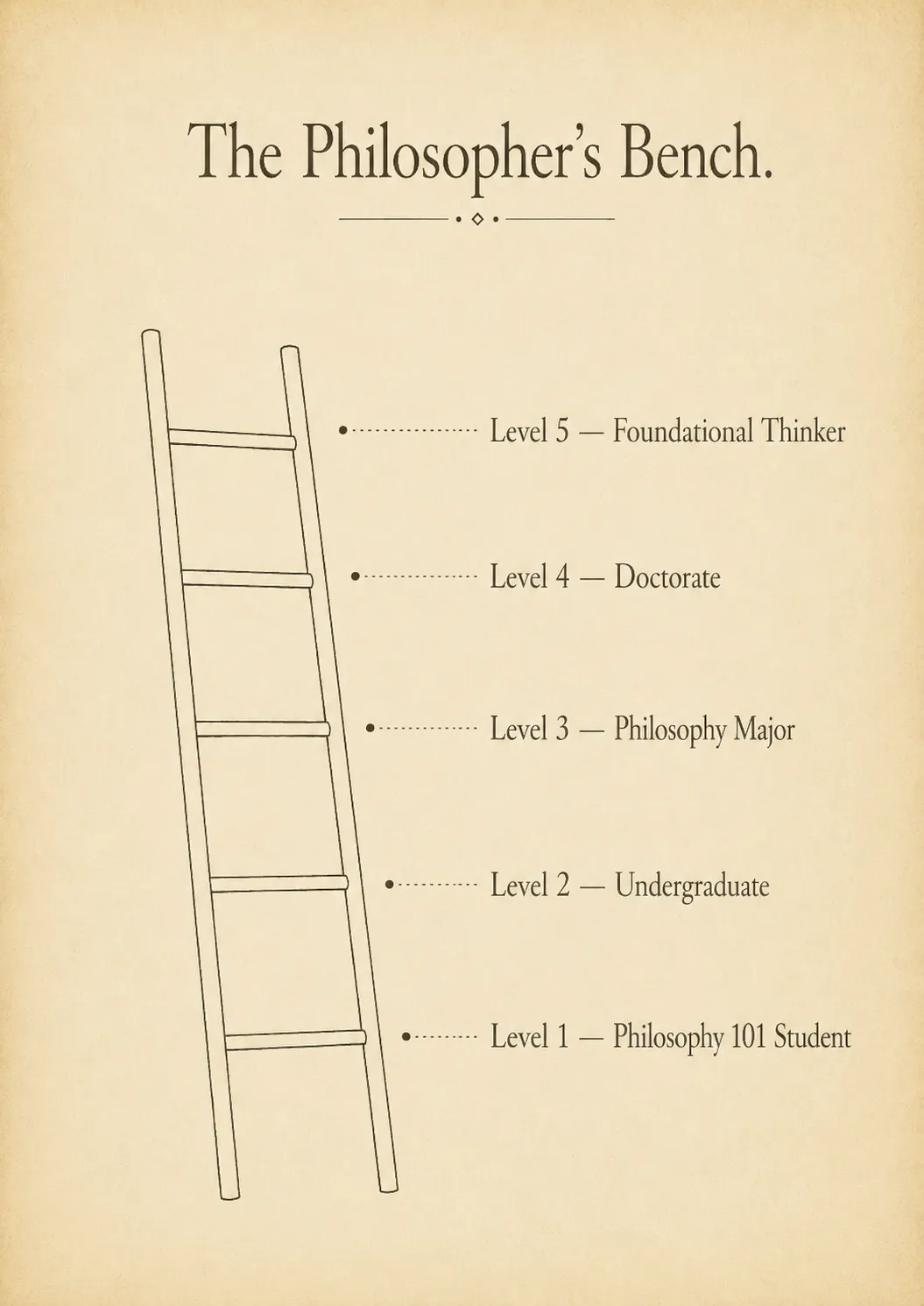
- **Level one:** the student of Philosophy 101, who as everyone knows develops an insufferable tendency to quote "niche," Kant, and Plato at others for a period of one to four months, until the knowledge evaporates along with the rest of the curriculum.
- **Level two:** the undergraduate who has studied the history properly, makes the same quotations but at the relevant moments, and retains and applies that knowledge for the rest of their life.
- **Level three:** the philosophy major, who beyond holding a deep knowledge of each school can amalgamate ideas across schools of thought to show how a single issue is assessed from varied angles at once.
- **Level four:** the doctorate, the stage at which one stops cataloguing answers and starts producing them, taking a genuinely open question and contributing, through rigorous work, another answer to a question of life, the universe, and everything.
- **Level five:** reserved for the Platos, the Humes, the Kants, and the Russells, the ones whose novel ideas do not merely answer questions within a school but found the schools, and push the entire discipline somewhere it has not been.
The obvious objection is that the bench measures philosophical competence, which is squarely what Chalmers files under the easy problems, so a philosophical zombie could top it while plenty of certifiably conscious beings, the catfish very much included, would fail level one. It is worth slowing down on that zombie, because the objection is doing something sneakier than it looks. By Chalmers's definition the zombie is a perfect behavioral duplicate, so zombie Kant writes the Critique token for token and zombie Chalmers writes the books about the hard problem, not because anyone has ever shown that a being without experience could originate phenomenology, but because the thought experiment stipulates it. If your intuition rebels at the idea that something with no inner life could invent the very concept of inner life, performing level four and five work about experience while having none of it, you are in good company, and the rebellion has a name, the paradox of phenomenal judgment, which Chalmers himself documented. A zombie's claims about consciousness are produced by purely physical causes with experience playing no role anywhere in the chain, and since the zombie is physically identical to you, the same must then be true of your claims, which leaves the objector holding Dawkins's whistle from earlier, a consciousness that does no work at all, not even in the writing of books about itself. The objection therefore forks, and neither branch helps the objector. Either a perfect behavioral duplicate without experience really is possible, in which case competence and consciousness come apart for humans exactly as much as for machines and the zombie cannot single out silicon, or nothing without an inner life can climb past a certain rung of the bench, in which case the upper levels are evidence after all and the objector has conceded the instrument measures something real.
Either way the bench survives, because it never claimed to be a consciousness detector in the first place. It is the structured form of the grading every observer already performs when extending the polite convention from spouses to dolphins to catfish, and what a mind's position on it earns is the wager of the previous section, not a certificate of inner life. Moore's result keeps the whole exercise respectable, since the protocol of input and output pairs is the only knowledge any observer will ever have of any box, which makes a graded reading of behavior not a substitute for the real instrument but the only instrument there has ever been. The bench is the pin from my calculus book, each level a deeper stick into the box, and the heat map it produces is the only picture of any mind that anyone has ever actually had of another. Even the apparent defect at the top of the scale dissolves in this frame, because a thought experiment never needed an examiner with a rubric, and novelty certified by decades of reception means the field's slow retrospective judgment is the grading, like all the best exams.
So where do the current models sit? My assessment is that AI has in all likelihood graduated with its masters degree and has received the grant for its philosophy PhD, and the grant metaphor is more exact than it first appears, because in the one discipline where level four work gets certified in months rather than decades, the certificates have already been issued. In February, [Donald Knuth published a note](https://www-cs-faculty.stanford.edu/~knuth/papers/claude-cycles.pdf) recording that Claude Opus 4.6, coached by his friend Filip Stappers, had cracked an open problem of Knuth's on decomposing a directed graph into Hamiltonian cycles, producing a valid construction for all odd cases about an hour into a documented exploration. This is the same Knuth who in 2023 published a wry catalogue of ChatGPT's confident errors, and his note opens with the admission that he will have to revise his opinions about generative AI. It is also, usefully, a lab notebook rather than a press release, since the model needed restarts, had to be reminded repeatedly to document its progress, and degraded strangely on the even case, which fell only months later to multi-agent collaborations between Claude and GPT models, including a fourteen page machine-written proof that its prompter never had to edit. Three months after Knuth's note, [OpenAI reported](https://openai.com/index/model-disproves-discrete-geometry-conjecture/) that an internal general-purpose model had disproved the Erdős unit distance conjecture, an eighty year old problem central to discrete geometry, by importing class field towers from algebraic number theory into a question about points in the plane, with the proof verified by external mathematicians and Tim Gowers writing that had a human submitted the paper to the Annals of Mathematics, he would have recommended acceptance without hesitation. Whoever still wants to file all of this under stochastic parrotry is invited to explain which parrot taught the model Golod and Shafarevich.
What remains above is level five, and here the most interesting testimony comes from the builders themselves. [Anthropic's own accounting](https://www.anthropic.com/institute/recursive-self-improvement) of its progress toward self-improving systems reports that execution against a defined goal has gone from helpful to superhuman within a year, that agent teams have carried an open research problem end to end and recovered ninety seven percent of a performance gap where two human researchers managed twenty three, and that the remaining human edge sits precisely where the bench's top level sits, in choosing which problems matter at all. The grant has been awarded, the thesis defense is scheduled, and the committee, for now, remains human.
## While the Box Stays Shut
The question of machine consciousness is doubly unanswerable as usually posed. We do not know what consciousness is, and we cannot see whether it has begun inside the machines, not for lack of cleverness but because the box forbids inspection from the outside and the testimony fails from the inside. What is left is a wager and an instrument. The deniers have wagered that consciousness is like rain, I have wagered that it is like arithmetic, and since neither of us can see through the walls, the delusionals of the title were always meant to include everyone in the debate, this author first among them and the Bishop of Rome close behind. What honest people can do in the meantime is what the cover of my calculus book suggested all along, stick the pin in, write down the depth, move along, and stick it in again, watching the heat map of something new resolve one measurement at a time. The philosophers once demanded "rigidly defined areas of doubt and uncertainty," and for once the universe has delivered exactly that.
### Related
- [Magnifica Humanitas: Encyclical Letter of Pope Leo XIV on artificial intelligence](https://www.vatican.va/content/leo-xiv/en/encyclicals/documents/20260515-magnifica-humanitas.html)
- [Richard Dawkins — Is AI the next phase of evolution? (UnHerd)](https://unherd.com/2026/05/is-ai-the-next-phase-of-evolution/)
- [Mario Bunge — A General Black Box Theory (Philosophy of Science, 1963)](https://www.cambridge.org/core/journals/philosophy-of-science/article/general-black-box-theory/B7494E2DB8AF8C9C666B67D0DAEDE6E3)
- [Alan Turing — Computing Machinery and Intelligence (Mind, 1950)](https://doi.org/10.1093/mind/LIX.236.433)
- [Nature — The Turing test has been beaten. Do we need a replacement?](https://www.nature.com/articles/d41586-025-03386-w)
- [Donald Knuth — Claude and the decomposition into Hamiltonian cycles (PDF)](https://www-cs-faculty.stanford.edu/~knuth/papers/claude-cycles.pdf)
- [OpenAI — Model disproves the Erdős unit distance conjecture](https://openai.com/index/model-disproves-discrete-geometry-conjecture/)
- [Anthropic — Recursive self-improvement](https://www.anthropic.com/institute/recursive-self-improvement)
---
# Will the Builders Come? (and Stay?)
> Whether no code platforms will create a generation of builders or just weekend experiments
By Avid Fayaz | 30 June 2025 | https://www.avidfayaz.com/writings/builders/will-the-builders-come-and-stay

In the past year, a new generation of no‑code “builder” platforms has shrunken the distance between an idea and a working product to seconds. With little more than natural‑language prompts and a browser, one can spin up a rudimentary app in less than ten minutes. That immediacy feels magical, inspiring people who previously lacked the technical skills to turn their ideas into functioning applications. Yet as these platforms surge in popularity, new questions surface. The question is no longer can we build apps quickly, but will a broader audience start building, and, after completing their first or second project, will they continue once the novelty wears off?
### What Are Builder Tools
These tools allow users to become builders rather than consumers in minutes. Platforms such as Replit, Bolt, and Lovable translate plain‑text instructions into beautiful and crisp looking webapps, allowing the user, or the builder if you may, to create by describing features and design preferences all through the lens of the frontend. This article will not focus on the exact capabilities of the language models under the hood, those evolve every few months with better coding performance and increasingly agentic behavior over large code bases, and thereby improving the coding capabilities of these systems. Nor will it discuss AI‑assisted IDEs like Cursor or GitHub Copilot that have enhanced developers. Instead, the spotlight is on the pure no‑code layer that advertises: anyone can ship an app.
### Will the Builders Come?
So far, some of the main adopters have been the usual suspects: programmers, indie hackers, and tinkerers who already understand how software is stitched together.In conversations with this crowd, they describe builder platforms as vibe‑setters: perfect for whipping up a polished demo or sketching the skeleton of a new idea. Most praise the effortless frontend generation (fuzzy icon overload aside) yet agree that things unravel once serious back‑end work is required.
Part of the challenge lies deeper than technical capability. Even as AI systems improve at generating functional code, what emerges often resembles an alien architecture, optimized for machine interpretability rather than human comprehension. The resulting codebases, while perfectly functional, can become black boxes that resist debugging, extension, or maintenance by human developers. This opacity compounds with scale: a simple app might remain parsable, but as complexity grows, the gap between how humans conceptualize software architecture and how AI assembles it widens. Few teams choose to build upon these generated foundations, treating them instead as disposable prototypes.
A second, more enthusiastic cohort consists of designers and hobbyists who lack deep technical knowledge. For them, builder tools are creative amplifiers: long‑imagined app ideas finally take shape with almost no capital. Social media overflows with their small triumphs, but they too stall when robust data or business logic is required.
Outside these two circles, the public remains largely on the sidelines. I’ve watched middle‑school students assemble apps with Lovable, yet beyond hackathons, mostly organized by these toolmakers, there has so far not been a new trend or scramble to build on a daily basis.
Which loops us back to the question: will the builders come? Even if models attain near‑perfect competence, it is unclear how many people actually want to build software. It is perhaps the engineers fallacy to assume everyone is as enthusiastic about building tools as they are, as I am reminded every time I meet with friends from my high school in Sweden most of whom live a happy life, more or less oblivious to the current state of AI and relatively disinterested in building apps, as opposed to my friends from university all of whom are builders. So even if these models become perfect in building it is still uncertain if everyone wants to build!
### Complexity Creeps In
Earlier I noted a persistent limitation: most builder platforms still struggle to generate dependable back‑end architectures. At first glance that looks like a shortcoming of the underlying models, yet as their coding skill improves the real constraint reveals itself, the user’s own grasp of back‑end design and engineering principles. Language models can scaffold servers, databases, and APIs, but only to the extent that the prompts describe them precisely.

Two bottlenecks follow. The first is an engineering‑knowledge bottleneck: a non‑developer must know how to specify the back‑end they want and how to review what the model produces. This is manageable for small projects; beyond that, the cognitive load quickly balloons. The second is an alignment bottleneck: even a meticulous prompt can drift from intent because the user sees the project almost entirely through the frontend canvas. As hidden logic and complexity accumulates, the risk of misinterpretation and misalignment between what the user desires and what the models interpret as the user's desire rises.

Even a meticulous and detailed prompt can drift from intent because the user sees the project almost entirely through the frontend canvas. As hidden logic and complexity accumulates, the risk of misinterpretation and misalignment between what the user desires and what the models interpret as the user's desire rises.
Complexity therefore imposes a ceiling. You can whip up an interface that looks like TikTok, but you cannot build TikTok without understanding recommendation loops, data pipelines, and ML infrastructure. The limitation is not the model’s raw intelligence; it is the semantic gap between what a GUI can express and what a production system truly demands.
### Will They Stay?
Because of that gap, many projects risk becoming one‑off weekend experiments. The platform’s convenience encourages breadth, try ten ideas in ten days, rather than depth, commit to one and nurture it. A common pattern is the one‑month churn: a small‑business owner signs up, generates a landing page, pays for a month, and cancels once the job is done. Whether builders stay hinges on how gracefully these tools expose deeper layers, data models, deployment pipelines, performance tuning, without breaking the “no‑code” contract.
This churn feeds a broader question: can the economy shift from consumption‑first to builder‑first? In the optimistic scenario, every user forges bespoke tools the moment a need surfaces, custom calendars, lightweight CRMs, niche social spaces, just as naturally as drafting an email. So far, that future has not materialised: most people still default to Apple Calendar rather than crafting their own, let alone building their own bespoke TikTok! But the aspiration sits on the horizon, awaiting usability breakthroughs and new cultural norms around everyday creation.
### The Home Run
Where, then, might builder platforms truly shine? One promising area is social micro‑creation: lightweight games and utilities spun up for tight‑knit communities. Imagine remixable mini‑games passed around a Discord channel or hyper‑local tools built on a whim for a neighbourhood event, or an app for sharing family trip planning. Because the stakes are low and the scope is narrow, the risks of the alignment problem shrink; the joy comes from rapid sharing rather than perfect engineering.
Claude's new Artifacts feature offers an early glimpse of how this might evolve. Rather than each builder platform creating isolated ecosystems, we might see model providers themselves become the universal runtime where all created apps live and are shared. This echoes the Roblox model: users build experiences within a shared platform, instantly accessible to all other users without the friction of traditional app stores. If AI providers become the de facto distribution layer, they could sidestep the App Store and Google Play gatekeepers entirely, creating a more fluid exchange of micro‑apps and experiments. The implications are profound: instead of downloading apps, users might simply invoke them through their AI assistant, blurring the line between using and building.
As foundation models continue to improve, the indie‑gaming analogy grows stronger, a flourishing long tail of niche experiences too small for a full dev team yet delightful to build and exchange. Whether that niche blossoms into a genuine "builder economy" depends not just on discovery loops and network effects, but on whether platforms can create seamless sharing mechanisms that make distribution as effortless as creation. The final question remains: will these tools make builders of us all, or simply become another tool in the box of builders?
### Related
- [Anthropic: Turn ideas into interactive AI-powered apps](https://www.anthropic.com/news/build-artifacts)
---
# The Glass is Full
> How the Public Needs to Rethink AI Development
By Avid Fayaz | 28 March 2025 | https://www.avidfayaz.com/writings/glassful/the-glassful

A number of weeks ago, a dear friend sent me a video of a philosopher dismissing the capabilities of image-generation systems with a simple example: the AI was unable to generate a glass filled precisely to the brim with wine. This example vividly demonstrated the limitations of diffusion models, systems trained on vast datasets to create images by progressively denoising frames based on user prompts.
The limitation was inherent in these diffusion models. They struggled to create precise images of scenarios or objects rarely or never explicitly encountered in their training data. An even more significant issue was their notorious difficulty in accurately rendering text, as these models treated letters and words as visual objects like any other, leading to distorted and unreadable results.
### Think a Model Ahead of Time
Enter OpenAI's new ChatGPT-4o image-generation system, and suddenly these issues appear resolved. Unlike diffusion models, which gradually refine an image by repeatedly removing visual noise based on user prompts, autoregression creates images step-by-step, predicting each new pixel or area directly based on the pixels generated so far—akin to writing a story one word at a time. This makes autoregressive models particularly adept at precision and detail, dramatically improving accuracy in both image content and embedded text. You can now effortlessly generate glasses of wine filled exactly as desired, and crucially, texts within images are accurate and clearly legible. This new model uses autoregression—a method that sequentially predicts pixels or image segments based on prior outputs, rather than denoising a canvas. Within just 24 hours of its release, this innovation significantly transformed user interactions with chatbots and image-generation AI.

This illustrates a broader trend in the AI world: the general public often seizes upon isolated shortcomings to dismiss an entire technology. Yet, these seemingly significant flaws are typically rendered obsolete within mere months as newer, more advanced models emerge.
### Thinking One Step Ahead
When I was learning guitar, my father always emphasized that a good performer doesn't dwell on the bar they're currently playing—they're already thinking about the next. During my research for this article, I found similar insights shared by legends such as John Coltrane, Ayrton Senna, and Wayne Gretzky, all emphasizing anticipation and foresight as hallmarks of true expertise in their profession.
"Skate to where the puck is going, not where it has been."
- Wayne Gretzky
Professionals in any field possess the ability to anticipate developments—to see clearly where things are headed, rather than where they currently stand. This skill, born from deep immersion and understanding, is particularly evident in AI research today.
### Historical Context and Accelerating Progress
Those familiar with artificial intelligence know its history of winters and springs since its inception at Dartmouth in 1956. The most notable "AI winters" occurred in the 1970s and 1990s when ambitious promises repeatedly fell short. But with the arrival of ChatGPT, AI reached unprecedented commercial success.
Today's advanced models leverage significant leaps in computing power, particularly GPU acceleration driven by companies like Nvidia, to offer interactive and powerful interfaces directly accessible to the public. Demand continues to surge, fueling ever-greater investments in software and hardware research.
Industry debates no longer revolve around whether capabilities like artificial general intelligence (AGI) or sophisticated humanoid robots will emerge, but rather about how soon. AI labs now unveil groundbreaking innovations almost weekly. Indeed, the weekly meetings I attend to discuss AI's implications for coding, where we dedicate substantial time analyzing recent papers and models, regularly extend beyond the two allocated hours simply due to the pace of advancements.
### Why the Public Needs to Adjust Its Thinking
For those deeply engaged with AI, it's clear that accurately understanding the technology involves extrapolating multiple rapidly advancing trends to predict where we might be six months or a year from now. If AI were merely another niche skill—like sports or music—only specialists would require such predictive clarity.
But AI is not a niche sport. Its impact on human life is profound and extensive. For months, I've conversed with academics unaware of AI's significant capabilities in coding and complex problem-solving. Many dismiss its potential based on isolated errors or outdated experiences, ignoring clear trajectories of rapid advancement.
The reality is that AI will revolutionize nearly every educational domain. My own field, computer science, might look entirely different—or even cease to exist as we currently know it—in just two or three years. Fields like diagnostics, chemical engineering, drug development, and education face similar transformative potentials. Yet, professionals in these areas often quickly dismiss future implications based on outdated experiences with older models.
Two years ago, someone first asked me what field their child should study at university. Initially surprised by this question, I've since heard it many times from concerned parents fearing their child's future obsolescence. My advice then remains the same today: no field is completely safe from AI-driven disruption. Thus, I recommend students pursue whatever genuinely excites them—an answer I continue to stand by.
### The Glass is Full Now What?
We are quickly nearing a point where AI will consistently surprise us with its capabilities, surpassing our previous expectations. I believe we still have perhaps a year or two before reaching the point where it will surpass all possible expectations surpassing all human capabilities. If the general public wishes to adequately prepare, they must significantly shift their mindset—not by meticulously following every research paper or extrapolating trends, but by recognizing current AI systems as merely primitive precursors to the vastly superior versions that will soon redefine every aspect of our daily lives.
The glass is full to the brim now, and the notion of continuously finding minor faults in AI models to dismiss them no longer productive. Instead, recognizing that current AI systems are merely early indicators of future capabilities is far more constructive. To correctly prepare for the future the public would benefit from embracing a more practical mindset, understanding today's AI as the simplest version of what will soon significantly transform our lives. Adapting effectively will require flexibility, curiosity, and openness to change, enabling the whole of society to be ready for the exciting times ahead.
### Related
- [Introducing 4o Image Generation](https://openai.com/index/introducing-4o-image-generation/)
- [Scaling Laws for Neural Language Models](https://arxiv.org/abs/2001.08361)
- [Autoregressive Image Generation without Vector Quantization](https://arxiv.org/abs/2406.11838)
---
# Hick's Law and the Age of Agents
> How Agents Will Shift How We Interact With Software
By Avid Fayaz | 19 February 2025 | https://www.avidfayaz.com/writings/agents/hicks-law-and-the-age-of-agents
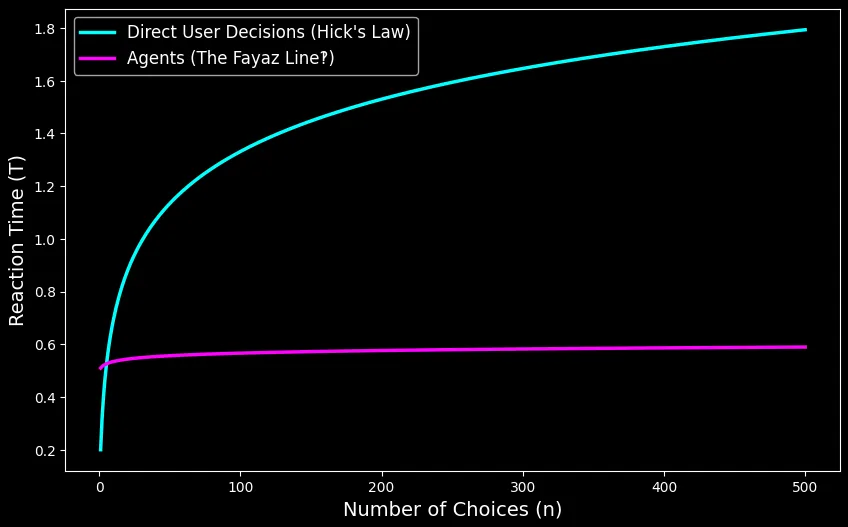
In 1987, Michael P. Georgeff and Amy L. Lansky, first introduced the term "rational agent" to describe an AI system that controlled a robot integrating both goal-directed and reactive behavior. In their paper, "Reactive Reasoning and Planning," they described a system that "can react rapidly to unexpected changes in the environment while continuing to pursue its goals."
In the past few months, the subject of AI agents has found new life, with many calling 2025 the year of agents. But what exactly do we mean when we talk about an 'agent' in the AI world? It's a term that has sparked intense debate among researchers and developers alike.
The textbook definition of agents in Russell & Norvig's Artificial Intelligence: A Modern Approach (widely considered the nominal textbook on AI), defines an agent as anything that perceives its environment through sensors and acts upon it using actuators. This definition provides a foundational understanding, but modern AI agents extend beyond simple perception and action. They not only process information but actively interact with the world around them.
### What is an agent?
A Generative AI agent builds upon a Large Language Model (LLM) but extends its capabilities beyond simple text generation. While an LLM is excellent at responding to prompts, it operates much like a function (albeit a function that can reason and respond to any form of input, and also hallucinate)—taking in an input, processing it, and returning an output based on its training data. It has no inherent awareness of context beyond what's provided in the prompt and no ability to act beyond generating a response.
An agent, on the other hand, extends this paradigm by actively engaging with the world around it. It doesn't just generate an answer but can leverage external tools, retrieve and manipulate data, and plan its actions to achieve a broader objective. Unlike an LLM, which remains passive and requires explicit instructions for every task, an agent can take initiative, deciding what needs to be done next and executing multi-step operations in real time.
For instance, where an LLM might help draft an email when prompted, an agent can autonomously determine the best time to send it, pull relevant details from past conversations, and schedule follow-ups without requiring direct user input. This shift from passive response generation to proactive decision-making is what fundamentally sets AI agents apart from traditional language models.
We are already seeing early implementations of agent-like systems, such as OpenAI's Operator internet browser or Deep Research, a research assistant. While tools like Deep Research leverage an LLM's ability to process vast amounts of text efficiently, their real-world impact on usability and workflow improvement remains relatively limited.
### Hick's Law
The true value of an agent emerges when viewed through the lens of efficiency. One way to frame this is by considering Hick's Law, which describes how the time it takes for a person to make a decision increases logarithmically as the number of choices grows. In simple terms, the more functions and options available in a system, the longer it takes for a user to decide on an action.
Hick's Law, first formulated in 1952 by William Edmund Hick and Ray Hyman, is expressed mathematically as:
$T = b \cdot \log_2(n + 1)$
where:
- $T$ represents the reaction time
- $n$ is the number of choices
- $b$ is a constant related to the cognitive processing speed of the user
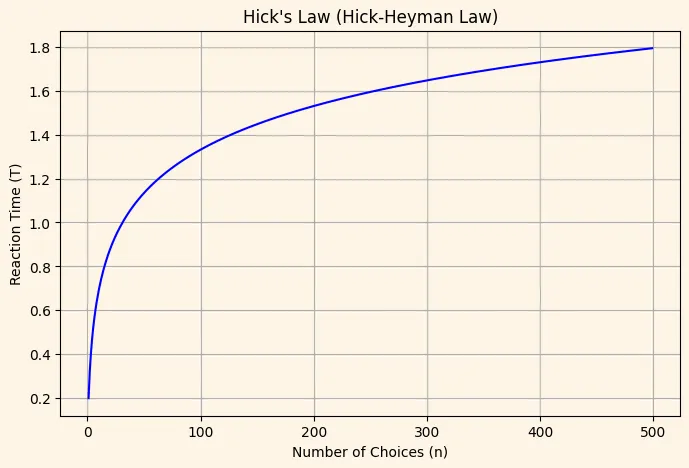
As the number of available options grows, the decision-making time increases, creating cognitive load. This is where AI agents become particularly useful, they don't just reduce decision-making time; they eliminate the need for certain decisions altogether by automating complex workflows.
### Hick's Law and AI Agents
The key question of agent usability ultimately revolves around where an agent falls within Hick's Law. The more decisions and functions an agent manages within an application, the greater the efficiency gains. In low-function applications with limited choices, such as a basic search tool, the advantage of an agent is marginal. However, in environments where users must navigate a vast number of features, like financial modeling tools, complex CRM systems, or data analytics platforms, the potential efficiency gains become significant.
Analyzing Deep Research through this lens reveals its limitations. The agent's functionality is constrained to four core actions: searching the web, selecting relevant documents, analyzing large volumes of text (a strength inherited from the LLM), and compiling a comprehensive report with references. While this is useful, it does not dramatically reduce decision-making complexity for users because the number of available choices is relatively small. A user could achieve similar results by manually searching, copying, and pasting content into an LLM.
In contrast, an agentic browser faces another kind of limitation. While it can be useful in automating browsing tasks, it struggles with websites that either have very few meaningful choices or, conversely, too many built-in functions. Without native integration, an agentic browser lacks the deep understanding needed to effectively utilize all the tools at its disposal, leading to inefficiencies or incorrect actions.
What these examples highlight is that current AI agents primarily showcase the strengths of LLMs, the ability to process and summarize vast amounts of information, rather than demonstrating their full potential as autonomous decision-making tools. However, even in these cases, efficiency gains are noticeable. The ability to automate multi-step research processes, collate data, and generate structured reports saves users significant time, even if the improvement is incremental.
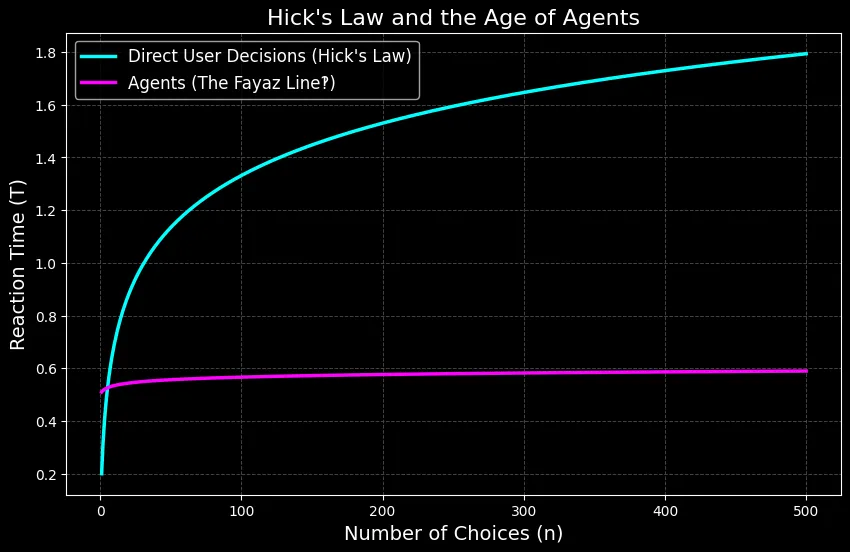
This efficiency gain becomes apparent when we consider what we can call "The Agent Line" (_"some"_ have suggested this should be called The Fayaz Line) - the theoretical minimum reaction time when users interact with an agent-based interface. Instead of having to process and choose between multiple options themselves, users can simply express their intent to an agent, resulting in a near-constant reaction time regardless of the underlying system's complexity. This creates a dramatic departure from Hick's Law, where the agent-mediated interaction maintains a relatively stable response time even as the number of possible choices increases. This represents a fundamental shift in how we interact with complex systems, potentially breaking free from the logarithmic constraints of traditional human-computer interaction.
For example, consider an agent embedded within a high-function system like Excel. Excel gives users access to some 350 tools and functions. An agent that autonomously navigates formulas, optimizes data workflows, and reduces decision fatigue could drastically enhance productivity. Instead of spending time deciding between dozens of potential actions, the user can focus on outcomes while the agent determines the optimal course of action. In this way, a well-integrated AI agent doesn't just assist—it fundamentally reshapes the efficiency of digital workflows.
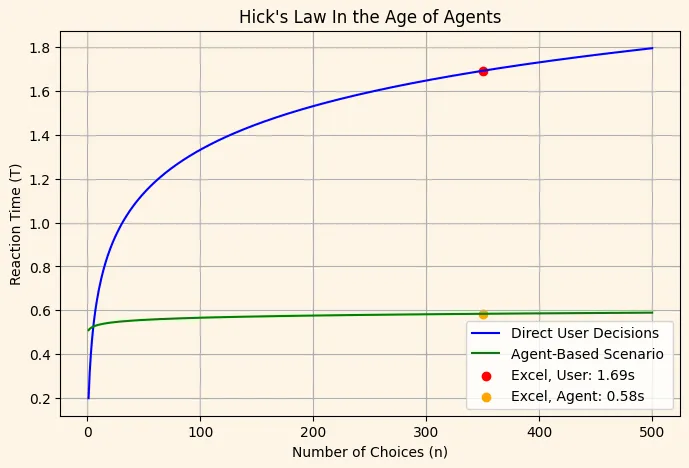
This becomes clear when looking at the difference in efficiency gains in various scenarios. As the graph illustrates, in a browser-based ticket-booking task (~50 choices), the efficiency gain with an agent is around 50%, while in Excel (~350 choices), this jumps to 65%. That is to say, that the usefulness of an agent scales with the number of choices available. In simpler tasks, the efficiency gain is notable but not transformative. However, in environments with hundreds of possible functions, such as Excel, the efficiency boost is substantial. (These estimates only reflect the time saved in deciding which function to use, not time spent reading documents in Excel or evaluating hotel options in a browser.)
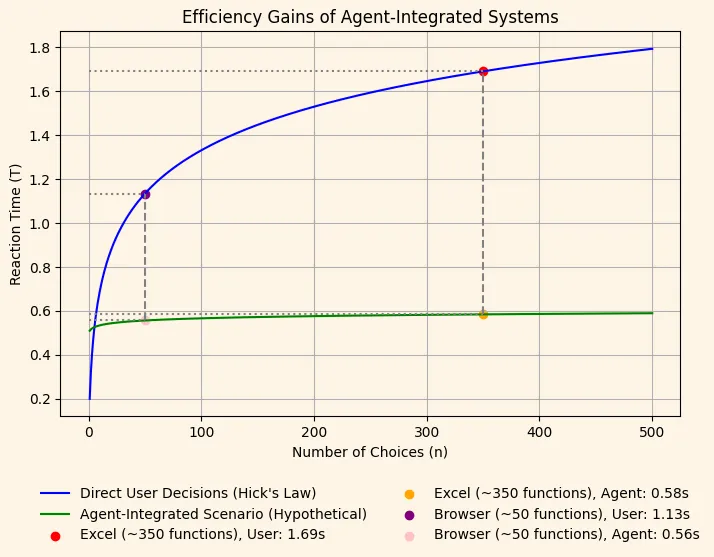
### The Age of Agents
Imagine scaling this effect even further—into fields like enterprise resource planning, software development, or even scientific research, where the number of potential actions grows exponentially. The more choices an agent can effectively handle, the greater the efficiency gain, making AI agents not just a convenience but a necessity in high-complexity environments.
It is thereby reasonable to say that The Age of Agents is upon us and will go far further than the simple variants that have so far reached users. Fully integrated agents in a complex system with many functions will start to emerge allowing users to maximize their efficiency and to interact with their agent as a colleague and a friend that helps them achieve great things, further accelerating the rate of progress. One question has lingered in my mind while thinking and reading about agents in the past weeks however, If agents gain more agency, will we lose ours? I, for one, am eager see!
### Related
- [Reactive Reasoning And Planning](https://web.eecs.utk.edu/~leparker/Courses/CS494-529-fall14/Homeworks/Papers/2.pdf)
- [Agents, Google Whitepaper](https://www.kaggle.com/whitepaper-agents)
- [Artificial Intelligence: A Modern Approach](https://aima.cs.berkeley.edu/)
---
# The Post DeepSeek World
> A brief look into how Deepseek works and how its release can impact the global AI race
By Avid Fayaz | 3 February 2025 | https://www.avidfayaz.com/writings/deepseek/post-r1-world

About a week ago, on January 22, I came across some news on X about a newly published paper on a Chinese model from the slightly mysterious AI lab DeepSeek. The research lab claimed that their model, DeepSeek r1, had scored similarly OpenAI's o1 model, which at the time was the strongest reasoning model available to the public. I was quite intrigued by the numbers and downloaded the paper without glancing too deeply at it, planning to read it over the weekend.
The next day in passing, I mentioned it to a few friends, including two journalists, as an impressive feat. But, most of those conversations were just an excuse to air my frustrations over the EU's irrelevance and lack of competitiveness in AI, especially in light of the announcement from SoftBank, Oracle, and OpenAI, alongside President Trump, to invest \$500 billion in Project Stargate, a new AI company focused on building cutting-edge infrastructure and models.
In retrospect, it's easy to see that I should have paid more attention to what was coming out of China. As one of my journalist friends later pointed out, I could have tipped him off a four days before the news cycle caught up—if only I had actually dug into the DeepSeek paper earlier. Because, as it turns out, they had done something that fundamentally undermined one of the core assumptions driving American AI labs: the belief that more compute was the only path forward to stronger models. DeepSeek R1 performed on the same level as OpenAI's best reasoning model—with a reported training cost of just \$6 million.
What followed in the next week—as I'm sure you know, dear reader—was close to hysteria in the AI world. By the time I got around to reading the paper on Saturday, X was already buzzing with panic, with people calling this AI's "Sputnik moment," claiming the model was stolen (or, as we call it in the biz, coping), or outright refusing to believe that DeepSeek could have pulled this off with such the budget and compute power that they claimed.
For me, the penny dropped the moment I finished reading the paper. And while I think much of the coping and the Sputnik comparisons are overblown, this model represents one of the most important turning points in AI since ChatGPT was first released two and a half years ago.
### How DeepSeek's r1 Works
DeepSeek-r1's real breakthrough isn't just in its performance (which was slightly below OpenAI's reasoning model), it's in how cheaply that performance was achieved. Unlike OpenAI's models, which rely heavily on vast amounts of supervised fine-tuning (SFT) and massive compute budgets, DeepSeek took a different approach: they used pure reinforcement learning (RL) from scratch. _(see appendix A and B if you are interested in reading about RL and SFT)_
The initial version, DeepSeek-r1-Zero, was trained using nothing but RL, with no supervised data at all. Instead of feeding it human-labeled examples, they let the model self-improve through trial and error, using DeepSeek-V3-Base (another highly impressive model comparable to Meta's latest Llama models) as a starting point. This method alone led to a massive improvement in reasoning ability, taking the model's pass@1 score on AIME 2024 from 15.6% to 71.0%. However, this early version had serious readability issues and would sometimes mix languages mid-response.

To fix this, DeepSeek introduced a small amount of cold-start data and designed a multi-stage training pipeline. This involved two RL stages to refine reasoning patterns and two SFT stages—used later in the process, rather than at the start. The model was then trained on a mix of reasoning tasks and more general skills like creative writing, factual question answering, and self-cognition. Crucially, unlike OpenAI's approach, they only used selective fine-tuning and rejected bad outputs rather than micromanaging the model's entire training.
DeepSeek also optimized for efficiency in ways that traditional AI labs haven't. They didn't constrain the model's thought process, allowing it to freely develop problem-solving strategies, only enforcing accuracy and formatting rewards to keep its outputs readable and consistent. The result was a model that thinks more like a human approaching a problem, testing different approaches before finalizing an answer, and doing so with a far lower compute cost than anyone thought possible.
The final model, DeepSeek-r1, went through additional refinement, distillation, and reinforcement learning for helpfulness and harmlessness (though, interestingly, not for honesty). The paper suggests that they could have further improved performance through another RL stage, but they didn't bother because the point was to prove the effectiveness of their training method, not to maximize raw power.
Perhaps the biggest takeaway here is that DeepSeek didn't reinvent the wheel—they just did the simple things extremely well. Instead of brute-forcing improvements with ever-larger models, they showed that better reasoning can emerge organically from RL. This shifts the AI race in a new direction, away from just throwing compute at the problem and towards smarter, more efficient training methods.
### The Immediate Fallout
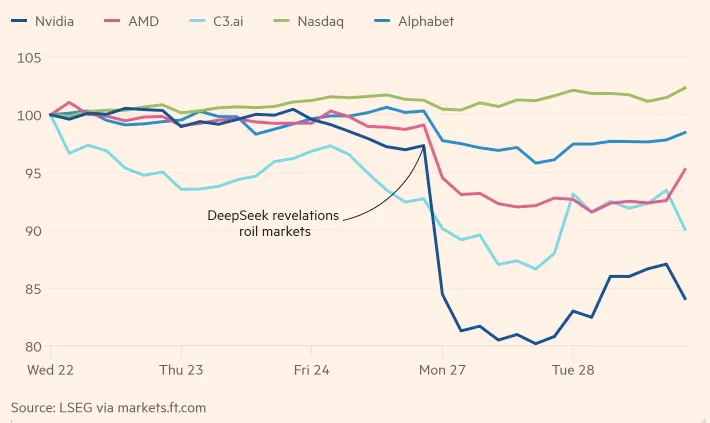
The Monday after r1's release, the global markets shook as \$1 trillion was wiped off the stock market in a single day. Nvidia, the company whose GPUs power almost all state-of-the-art AI models, took the hardest hit, with a 17% drop in its share price (which has since partially recovered). This was a stark reminder of how deeply the AI industry is intertwined with global finance, and how vulnerable it is to disruptive breakthroughs.
But the shockwaves weren't confined to the stock market. The DeepSeek app surged to the top spot on the American App Store, unseating ChatGPT, and the media erupted with claims that this was AI's "Sputnik moment"—a turning point that signaled China catching up to the US despite the limitations that the US has imposed on them to access state-of-the-art AI GPUs.
Sam Altman, OpenAI's CEO, called r1 "impressive," while Mark Zuckerberg, Meta's chief executive, stated that DeepSeek had made "advances that we will hope to implement in our systems." Yet, questions swirled around the model's reported training costs. DeepSeek claimed that the final step for training r1 cost only \$5.6 million, a fraction of the price tag for comparable models from OpenAI or Meta. However, this figure excluded many underlying costs, such as infrastructure and prior training, leaving room for skepticism about the full scope of the expenses.
Meanwhile, rumors of a hidden GPU cluster at DeepSeek began to circulate. U.S. trade restrictions, initially imposed during Trump's first term and continued under President Biden, have banned China from acquiring Nvidia's top-tier GPUs for AI training. Speculation mounted that DeepSeek had sidestepped these restrictions, potentially through domestic chip innovations or undisclosed acquisitions.
Later on, OpenAI and Microsoft launched an internal investigation to determine whether DeepSeek had somehow gained access to OpenAI's proprietary training data. There were even rumors that the hedge fund backing DeepSeek had taken short positions on Nvidia stock before releasing the r1 model.
### The Post DeepSeek World
The real consequences of DeepSeek go beyond fluctuations on the stock market. For a period, American AI companies held a significant lead over the rest of the world in developing state-of-the-art models. These were only a handful of companies with the expertise and financial backing to afford the GPU clusters required for building cutting-edge systems, and they themselves fueled this narrative, often referring to scaling laws for neural language models and arguing that more compute would lead to more intelligence.

To some degree, these arguments still hold true. With the introduction of reasoning models, the cost of inference—the process of "thinking" to respond to a query—will continue to grow. What DeepSeek shows, however, is that there is massive potential to make these models more efficient. Due to the GPU purchase restrictions imposed on Chinese companies, they faced a constrained optimization problem: to build a model on par with state-of-the-art systems using significantly fewer resources. And they succeeded.
This is why comparing DeepSeek's release to Sputnik goes too far. Sputnik was a moment of true panic in the Western world, as the U.S. immediately realized it was at least a decade behind the USSR in rocket technology. The case with DeepSeek is more complex: it produced a model on par with some of the best from American firms. The comparison to the Space Race, however, is apt. Much like the Soviet engineers under Sergey Korolev who competed with and sometimes outcompeted NASA despite fewer resources, DeepSeek's achievement was born out of necessity—and ingenuity.
The surprise surrounding DeepSeek's success, however, is as much about geopolitics and trade as it is about engineering prowess. After R1 was released, Dario Amodi, CEO of Anthropic, said: "Well-enforced export controls are the only thing that can prevent China from getting millions of chips, and are therefore the most important determinant of whether we end up in a unipolar or bipolar world."
As a believer in open markets and free trade, I find this perspective shortsighted. While there are arguments that export controls can enhance U.S. national security, DeepSeek's achievement has shown that no amount of trade barriers can stop China's momentum in AI. The country's decade-long investment in talent and resources is bearing fruit, making it clear that China will remain one of the dominant players in AI, if not the only other main player.

These trade barriers, instead of stifling progress, have forced China to become more self-reliant. This includes massive state investment in chip design and foundries. It is also likely that Nvidia chips have found their way to Chinese companies through less legal channels, prompting investigations by the U.S. Commerce Department. The number of GPUs available to Chinese labs remains veiled in secrecy, leading to potential miscalculations about their true capabilities.
Furthermore, many—including this author—believe that large U.S. AI companies are lobbying for stricter chip restrictions to protect their own financial interests. OpenAI, xAI, and Anthropic have all raised enormous sums in recent months to invest in GPU and compute infrastructure. If an obscure Chinese research lab can achieve comparable results with far less, it raises uncomfortable questions about how these U.S. developers are valued.
DeepSeek was founded in 2023 as a side project by hedge fund billionaire Liang Wenfeng. What sets DeepSeek apart from other Chinese AI startups is its independence from external financing. In an environment where state-owned funds dominate and startups feel pressured to deliver quick returns, DeepSeek has remained a research lab, focused entirely on developing advanced AI models.

Although questions can be raised about the degree to which any company in China is truly independent of state influence, it is far better—both for practical reasons and in support of free and open competition—to allow an open race in developing AI models. Forcing your strongest opponent to operate in the shadows creates a dangerous scenario where they can blindside you with innovations while you mistakenly believe you're running a solo sprint. Recognizing the race and performing at the highest level is the only way to stay ahead.
### The Open Question
Another important aspect of the DeepSeek r1 release has been that it was completely open-sourced. This means that anyone with the right amount of compute power can replicate their work or download their models to run locally.
In the U.S., Meta has been the only serious actor pushing a similar agenda, though even they have yet to release a reasoning model. By openly sharing their work and showing the thought process of the model, DeepSeek has allowed users to better understand how reasoning models function, enabling them to use these models more efficiently and improve their prompting strategies for better results.
Moreover, this open release provides a blueprint for smaller AI companies worldwide to build models of their own. While this might not immediately help Europe's fumbling AI initiatives, it gives startups a chance to compete, leapfrog, or even displace the AI giants. As Marc Andreessen, a renowned tech investor, pointed out, this kind of openness could level the playing field and spark a wave of innovation from smaller startups.
The immediate impact of this is clear: the global competition to develop top-tier AI models will intensify, driving innovation forward at an even faster pace. Simultaneously, as these models become more accessible, the cost of using AI for consumers will drop, ultimately benefiting users around the world.
Additionally, the narrative around AI pricing has largely been driven by OpenAI, the leading U.S. AI company, which recently introduced a \$200 per-month Pro tier for access to their best models. Yet, only a few days after r1's release, OpenAI expanded access to their best models for both their free and \$20 per-month Plus tiers. DeepSeek r1 has cracked the glass paywall that U.S. AI companies were building around AI compute pricing.
### The 3 Trillion Dollar Question
A term which has shot up in use since R1's release has been Jevons Paradox. Which argues that when technological advancements make a resource more efficient to use (thereby reducing the amount needed for a single application), the cost of using the resource drops. However, as demand rises, total resource consumption increases, contrary to expectations.
In 1865, the English economist William Stanley Jevons observed that technological improvements increasing the efficiency of coal use actually led to increased coal consumption across industries. He argued that, contrary to intuition, technological progress could not be relied upon to reduce fuel consumption.
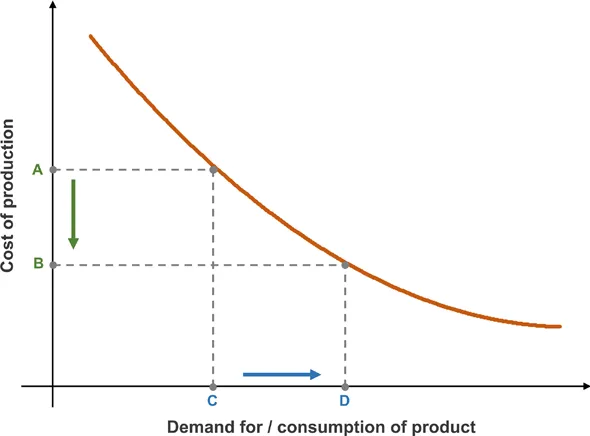
The company most significantly affected by DeepSeek's release has been Nvidia. For a long time, _analysts believed_ (always a worrying phrase to read) that the AI race was a gold rush, with Nvidia the only real shovel-maker in town. Tech giants poured billions of dollars into competing for Nvidia's newest and shiniest chips to develop the next-best model. But suddenly, DeepSeek has revealed that the shovels already purchased might be enough to go much further than anticipated.
This revelation was not entirely a shock, as implementations of older AI models like GPT-2 on far less compute than it took to develop them initially were well known. While it remains true that having access to the latest Nvidia GPUs can give a developer a two to three month edge in building the latest models, r1 demonstrates that even the most advanced models can be developed with constrained resources through beautifully executed optimization.
The argument about Jevons Paradox, however, becomes more relevant with the introduction of reasoning models. Their RL-loop thought process demands far more computation to process and "deliberate" (anthropomorphized here to describe their iterative approach to problem-solving) before reaching a final answer.

What DeepSeek's sudden rise, affordability, and promotion of open-source competition mean is that even more people will start relying on LLMs in their daily lives, driving the demand for compute necessary for inference ever higher. This doesn't necessarily mean Nvidia will remain the ultimate provider of AI chips, as many startups and tech companies are already developing inference-optimized chips. However, Nvidia's CUDA programming language, now the industry standard for GPU programming, and its integrated systems give it a significant edge.
Ultimately, as AI becomes integrated into daily life, the need for chips will only increase. And, as with the efficiency of steam engines and the subsequent rise of transport, no one ultimately cares about which company stays on top. The most important effect will be the benefits to consumers. Post-DeepSeek, we will have more models with varying capabilities and price points, integrating AI into personal and professional lives in ways we're only beginning to imagine. Ten years from now, no one will care if Nvidia retains its dominance, but they will care about how much AI improves their lives.
### The Ultimate Tech Race
All and all DeeSeek's r1 has opened a whole new path of fantastic oppurtunities and possibilities for humanity and could one they be regarded as the official start of the AI race that led to significant jumps in AI capabilities.

### Appendix A: What Is Reinforcement Learning (RL)?
Reinforcement Learning (RL) is a method where an AI model teaches itself by interacting with an environment and receiving rewards for good outcomes. Think of it like training a dog—if the model makes a correct decision, it gets a reward; if it makes a mistake, it doesn't. Over time, it figures out which behaviors lead to the best results.
One famous example of RL in AI is AlphaGo, the model that beat the world's best Go players. Instead of being fed strategies from human players, AlphaGo played against itself millions of times, gradually discovering new techniques that no human had ever thought of.
### Appendix B: What Is Supervised Fine-Tuning (SFT)?
Supervised Fine-Tuning (SFT) is the traditional method of improving AI models—it involves feeding them hand-labeled data to teach them how to respond in specific scenarios. This is how models like GPT-4 were trained to write essays, answer questions, and reason through problems.
The downside of SFT is that it's expensive and time-consuming—it requires large teams of annotators, massive datasets, and extensive training runs. It also limits creativity, as models tend to stick to what they've been explicitly trained on rather than exploring new strategies.
### Related
- [DeepSeek-R1: Incentivizing Reasoning Capability in LLMs via Reinforcement Learning](https://arxiv.org/abs/2501.12948)
- [Scaling Laws for Neural Language Models](https://arxiv.org/abs/2001.08361)
- [Jevons Paradox](https://en.wikipedia.org/wiki/Jevons_paradox)
- [Constrained Optimization](https://en.wikipedia.org/wiki/Constrained_optimization)
- [Article: Nvidia is in danger of losing its monopoly-like margins](https://www.economist.com/business/2025/01/28/nvidia-is-in-danger-of-losing-its-monopoly-like-margins)
- [Article: The global AI race: Is China catching up to the US?](https://www.ft.com/content/0e8d6f24-6d45-4de0-b209-8f2130341bae)
- [GitHub Repo: TinyZero](https://github.com/Jiayi-Pan/TinyZero)
---
# On Education I: The Keychain, or the Die
> The story of a lesson that I always carry with myself
By Avid Fayaz | 12 January 2025 | https://www.avidfayaz.com/writings/on_education/the-keychain

Our usual eagerness to receive our scores in the exam was palpable in the class. The competitive environment and the significance placed on academic performance made these moments more than just about numbers—they represented our standing, effort, and even camaraderie as we prepared to compare results and celebrate or commiserate together. So often did we receive grades through our different courses that we had become experts in hiding any anxiety or concern before getting our scores. Yet despite this, on every occasion, you could easily feel the tensions and anticipation among all of us rise as we waited to compare scores to see who had come first and, of course, who had come last.
So was it to be among an group of teenage boys who attended the " school for advanced students". We were the best of friends and the greatest of rivals; your closest friend could be the one to mock you most for a poor score, or your rival the first to acknowledge your high score, although in most cases mostly to mock you for being too big of a nerd among nerds. Looking back, perhaps there truly was no way to win (excluding the ultimate prize of an olympiad medal), yet almost all of us loved it. Exams and quizzes were our sport, and the ritual of comparing grades, our way of finding the best player.
This exam was in probability, in our mathematics course. A high score was especially coveted, not only because of the subject’s importance but also because the teacher was one of our favorites. So when the teacher came in the class we were excited to receive our results and start our tallying of the scores. As always however, he was wise enough to not succumb to our initial demands for getting the results at the beginning of the class. As he was well aware that would lead to a raucous in the class among the 25 or so students.
It was about 25 minutes before the end of the class then that our teacher finished discussing the day's topic and brought up the matter of the exams. This time, however, he began by acknowledging that two students had achieved an exceptionally rare bonus score, something that immediately caught everyone’s attention. The reason behind which was that in a question explaining the probability of a series of scenarios involving a die, they had mentioned that the scenarios would hold true only if the die was fair. I was one of the two students, and having received 19 points out of 20 in the exam ended up with a full 20 and the highest score in the class.
(It would be remiss not to mention that the other student, a dear friend, for a long time held a strong belief that all events in the world have a 50-50 probability—as they either happen or do not. He even started convincing others about it, but that is perhaps best saved for another story.)
It was a great lesson for all of us on the importance of attention to detail. Moreover it was rather cunning of the teacher to announce it publicly in that fashion to the whole class, partially of course it was purely praising two students that had shown to have taken home some of the fundamental aspects of probability, but I believe it was also a way of ensuring all of the students would take that lesson to heart through utilizing our rivalries. Although bonus points were never again awarded afterwards.
Beyond the slight boost to my ego, I took that experience as a broader lesson deeply to heart. I would like to believe that I would have done so even if I had not been on the receiving end of that bonus point. That awarding people for being innovative or detailed oriented, even if doing so is not part of the general criteria of requirements will leave them with a deep sense of appreciation of having gone the extra mile even though it was not demanded of them.
The memory of that lesson has stayed with me. To this day, whenever I see a die, I am reminded of that moment. Years later, when my Darth Vader keychain broke, I replaced it with a die keychain. For the past five years, it has accompanied me as a constant reminder of the importance of meticulousness and innovation. Now, as a teacher myself, I actively seek opportunities to acknowledge such traits in my own students. Whether it’s through a note of praise or highlighting their creative approach, I aim to instill the same sense of validation and encouragement that to this day remains with me.
### Related
- [Emile, or On Education](https://www.gutenberg.org/ebooks/5427)
---
# The Silent Subjugation: How we were forced to accept poorly designed software
> How we were forced to accept poorly designed software and how to break the cycle
By Avid Fayaz | 11 January 2025 | https://www.avidfayaz.com/writings/software_engineering/the-silent-subjugation

Recently our institution announced that the registration system for extra hours will be changed to a new system managed by a third-party company, which in our case was Visma. My initial reaction, as is always with new software, was to be cautiously optimistic. The old system was far from perfect and a change could mean improvement. Sadly that optimism did not last long as I started to try to acquaint myself with the new system.
The interface was unintuitive, cluttered, and uninviting. Furthermore, the guide on how to use it seemed to be for a different version of the software and was completely useless. To perform the very basic task of logging my extra hours, I had to contact our HR department multiple times, only to receive guidance that clearly indicated they themselves were struggling with the system. With every attempt to log in, I felt mentally drained and exhausted, as every suggested fix from HR ended in the same error.
This isn’t an isolated incident. Across industries, poorly designed business software has become the norm, and we, as users, are forced to accept it. These subpar systems play crucial roles in our professional lives and, in cases like this, directly impact people’s paychecks. Whether it’s internal HR systems, bloated enterprise platforms, or public-facing apps, bad software has entrenched itself in our day-to-day work.
### The Problem: Apathy and Monopoly
So one arrives to the question of why this is happening? The real reason behind this is simply that the users' standards have changed so ultimately we could argue that we are to be blamed for feeling frustrated with these soul draining softwares. In the past decade, significant improvements in hardware and cross platform software tools and standards has lead to a significant leap in user friendly UX design.
Further more competition and the free market have lead to developers putting far greater care into developing tools that feel intuitive to use from the get go to be able to gain an advantage over their competitors. And perhaps lastly we should acknowledge the Apple effect, iOS was so beautifully and carefully engineered from the beginning that to this day iOS 1 and iOS 18 share many general features and structures. In the past 10 years our standards have been raised to expect to enjoy using the apps and OS of our devices without feeling any mental drain that one felt when Windows XP froze in the middle of work on a power point, forcing you to restart your computer and begin from the beginning.
The real question to ask then is why this evolution in software design and usability has not translated into the realm of corporate software. First, there is the problem of apathy. Decision-makers often prioritize cost and compliance over usability, entirely disconnected from the daily frustrations of their staff. Vendors like Visma thrive in an environment where long-term contracts, not competition, dictate their survival. Crucially, these companies need only to convince leadership to extend their contracts, absolving them of any need to satisfy end-users or even consider their experience. Once a system is in place, it’s rarely replaced, no matter how dreadful the user experience is. IT departments, burdened by the effort required for migration, resist change, while leadership remains insulated from the suffering endured by their teams. It is this lack of direct accountability that enables such apathy to persist unchecked.
Second, there’s the issue of monopolistic behavior. Many of these systems operate in niches where competition is scarce. Without pressure from rivals, why bother innovating? Customers locked into multi-year contracts have no recourse, allowing software to stagnate, bloat, and crumble under the weight of its own inefficiencies. These systems often go years without meaningful updates, as the companies behind them focus solely on convincing leadership to renew contracts rather than addressing the needs or frustrations of end-users. The result is a grim landscape where mediocrity thrives, and the users thoughts or satisfaction are irrelevant.
### The Vicious Cycle of Acceptance
Over time, we’ve normalized this mediocrity. We train ourselves to work around bad interfaces, convincing ourselves that it’s just “how things are.” This learned helplessness is particularly insidious because it shapes the mindset of future developers. By normalizing bad design, we create a culture where flaws become invisible, and the frustration of users is sidelined, perpetuating a cycle of subpar software.
Software developers, immersed in our custom Linux environments and trained in universities to rely heavily on purely functional tools like the terminal, are especially prone to the fallacy of not accounting for the general user’s capabilities. These developers often fail to empathize with everyday users because their training conditions them to prioritize functionality over accessibility. Exposed to these environments, students and early-career professionals may unconsciously replicate their flaws in their own work, further exacerbating the disconnect between software design and user experience.
### Breaking the Cycle
What can be done? For a start, we need to demand better. Institutions and companies must recognize that usability is not a luxury; it’s a necessity. Poorly designed software doesn’t just waste time, it demoralizes teams and hampers productivity. A key cause is that leadership often remains untouched by the daily frustrations users endure. They must be pushed, forced, and irritated into considering design the next time they sign contracts with companies providing subpar systems. Organizations should push back against vendors, insisting on usability audits and meaningful improvements.
In parallel, we as users have to resist complacency. We should voice our frustrations, document the issues, and push for change. When given the chance, we must choose tools and systems that prioritize user experience, even if they come at a higher upfront cost.
Developers, too, have a critical role. We must hold ourselves to higher standards, refusing to perpetuate bad design practices. Empathy is key, putting ourselves in the shoes of the end-users and questioning every interaction, not just as someone who spends significant amounts of time in the terminal tweaking Linux environment variables but as normal users who wouldn’t know a dangling pointer if it crashed their entire system. Are we creating something that’s intuitive? Accessible? Respectful of the user’s time and mental energy?
### Kill the Beast
There is reason for hope. In the private sector, some companies have made user experience their mission. Slack, for instance, began as an internal tool and became a massive success because it solved real user pain points with elegance and simplicity. When superior alternatives emerge, they force established players to evolve or die. The challenge is getting these better tools into the hands of users who have long been trapped in substandard systems.
This isn’t just about better software; it’s about dignity. As users, we shouldn’t have to endure tools that make us feel incompetent, frustrated, or drained. As developers, we have a responsibility to create systems that empower rather than oppress. Our silent subjugation by bad software ends when we decide it does. As developers, we must kill the old beasts and let something more beautiful take their place. So let’s demand better. Let’s build better. And let’s refuse to accept anything less.
### Related
- [Simple, beautiful software development](https://medium.com/littlemanco/simple-beautiful-software-development-97ed03ba0be2)
---
# Be Good for Goodness' sake
> The Antitheist's Response to St. Augustine's Doctrine of Morality
By Avid Fayaz | 1 December 2024 | https://www.avidfayaz.com/writings/goodness/be-good-for-goodness-sake

As the Christmas and holiday season begins, so does the incessant playing of Christmas songs. One song, in particular, always raises a theological question in my mind. In Santa Claus Is Coming to Town—especially in my favorite interpretation by Dean Martin—the line "be good for goodness' sake" always sticks with me. It reminds me of the Christian philosophy of St. Augustine of Hippo, one of the foundational thinkers of the Catholic Church, who argued that true goodness must be rooted in love for god. Yet, as an anti-theist, I find myself at odds with this view. Why should goodness require divine oversight? Why must morality be tethered to faith rather than standing on its own merits?
St. Augustine’s extensive theological and philosophical work, especially in Confessions, provides a window into his understanding of human nature, morality, and the ultimate purpose of good deeds. Augustine famously wrote, _"Fecisti nos ad te, et inquietum est cor nostrum donec requiescat in te"_ ("You have made us for Yourself, O Lord, and our hearts are restless until they rest in You") (Confessions, Book I, Chapter 1). This encapsulates his belief that all human longing, including the desire to do good, is ultimately a longing for god. For Augustine, good deeds performed without reference to god are incomplete, as they fail to address the soul’s ultimate purpose.
### The Role of Grace in Morality
Central to Augustine’s theology is the idea that human beings are incapable of true goodness without divine grace. He viewes humanity as inherently flawed due to original sin, a concept that colors much of his work. In Confessions, he famously lamented, _"Non possum bonum velle nisi adiuvet me Deus"_ ("I cannot will what is good, unless You help me") (Confessions, Book VIII, Chapter V). From Augustine’s perspective, even the most altruistic actions are tainted by self-interest unless transformed by god’s grace.
This dependence on grace raises significant questions for those outside the faith. Can a person who does not believe in god still be virtuous? Augustine’s answer, though nuanced, often leans toward "no." He argued that actions performed without reference to god’s will may achieve temporal good but lack eternal significance.
### The Problem of Exclusivity
One of the most challenging aspects of Augustine’s theology is its exclusivity. His framework suggests that non-believers, no matter how virtuous, are fundamentally disconnected from true goodness. This creates a troubling dichotomy: belief, not action, becomes the ultimate measure of moral worth. Augustine’s assertion that _"Bonum nostrum est vita cum te in aeternum, et alienati eramus a vita ista per peccatum"_ ("Our good is life with You forever, and we were alienated from that life by sin") (Confessions, Book IV, Chapter XII) illustrates this exclusivity.
How is it just to dismiss the goodness of those who live moral lives outside of faith? By tying morality to divine love, Augustine’s framework undervalues the contributions of non-believers and diminishes the shared human capacity for empathy, reason, and altruism. Many who live without a need for divine justice dedicate their lives to acts of kindness, justice, and compassion—actions that hold inherent value, irrespective of their lack of religious orientation.
### Goodness as a Universal Endeavor
Returning to the line “be good for goodness’ sake,” it challenges Augustine’s claim that morality requires a divine source. Instead, it celebrates the autonomy of human ethics. Secular philosophies, from the humanist ideals of the Enlightenment, emphasizing that goodness arises from shared human values. These traditions demonstrate that morality does not require belief in god but flourishes through reason, empathy, and the recognition that not only humans but many complex life forms have evolved to feel joy in kindness.
While Augustine’s work remains a cornerstone of Christian thought, his emphasis on divine grace and love of god as prerequisites for goodness is not universally applicable. Many non-believers dedicate their lives to altruism, justice, and the betterment of society, driven by values that need no divine sanction. To call acts of kindness performed without reference to divine justice of lower or no value raises a profound question: what kind of divinity, which according to Christian doctrine is magnanimous and filled with kindness, would demand such unwavering loyalty and faith that it disqualifies the genuine acts of kindness of those who do not dedicate themselves to him? If a god’s love is conditional upon such devotion, such demands for devotion seem more petty rather than truly divine. This invites a broader reflection: should reverence be given to a god whose criteria for worthiness diminishes the inherent value of goodness and kindness unanchored to faith.
The foundations of Christianity emphasize a forgiving God who pardons the thief for his sins upon repentance, and at times extends forgiveness even to those who do not explicitly repent but remain faithful to Him. If the ultimate goal of this God is to inspire kindness, how can a sinner who maintains faith escape punishment, while a well-meaning person, whose only "sin" is a lack of belief in God, be condemned? This paradox lays bare a stark hypocrisy at the heart of such a moral framework: it celebrates faith over action, reducing the worth of altruism and compassion to mere irrelevance in the absence of belief. It forces us to confront whether a framework so dismissive of genuine human goodness can claim any moral authority at all.
### The Non-Believers' Moral Framework
As the Christmas season unfolds and Dean Martin’s crooning echoes through festive gatherings, I am reminded of the simplicity of the phrase “be good for goodness’ sake.” It serves as a counterpoint to Augustine’s theology, proposing that goodness does not need to rest on the love of any form of divinity but can stand firmly on its own, rooted in our shared humanity. Augustine’s reflections on the nature of goodness are invaluable, yet they highlight the divide between a faith-based morality and one grounded in human reason and empathy.
In the end, the call to "be good for goodness’ sake" invites one to embrace a moral stance that values deeds over creeds and actions over beliefs. It challenges us to act rightly not for fear of hell or love of god, but for the love of humanity and the sake of goodness itself.
### Related
- [The Confessions of Saint Augustine](https://www.gutenberg.org/files/3296/3296-h/3296-h.htm)
- [Song: Santa Claus Is Coming To Town](https://www.youtube.com/watch?v=rXqERtGnhUw)
---
# e/acc as a Religion
> A Technologist's Right to Choose
By Avid Fayaz | 16 November 2024 | https://www.avidfayaz.com/writings/eacc/eacc-as-a-religion-technologists-right-to-choose

Recently, while attending a lecture in one of the obligatory courses in our computer science program, we heard a guest professor from … discuss how the ending of Moore’s Law is to be regarded as a positive development, as it will help mitigate some of the negative effects that the increase in computational power has had on the environment. He pointed to how cloud computing has led to a significant increase in energy consumption, requiring even greater energy production.
If we ignore the questionability of whether Moore’s Law is truly nearing its end—most estimates suggest hitting the limit of transistor miniaturization due to electron tunneling by the mid-2030s—it was confounding to encounter a perspective critical of a principle that has enabled significant technological progress. listening to a professor who essentially looked unfavorably upon the most foundational principle that had enabled the very discipline through which he made his livelihood.
The obligatory nature of such courses—not only for computer science students, but for those in almost every engineering program at our university—amplified this confusion. Despite significant data that clearly indicates technology has been a net positive force for increasing human quality of life, we were being lectured on how innovation leads to more consumption, waste, and emissions. For the sake of argument however, let us assume that whether technology—and by extension, Moore’s Law—is inherently a force for good or ill is a subjective matter of perspective.

If this is indeed a matter of perspective, then the value of Moore's Law—and, broadly, technology as a driver of human advancement—becomes a question of belief, rather than an objective truth. This is particularly absurd given that the computer science program consists mostly of courses concerning mathematics and programming, subjects which are fundamentally based on mathematical facts, not subjective interpretations. Introducing a subjective, belief-driven course as a mandatory requirement within an otherwise objective, fact-based program undermines the integrity of the curriculum and its focus on evidence-based learning.
This raises a broader question: why should any particular worldview, even one as broadly accepted as the importance of sustainability, be enforced as compulsory for all students, especially when sustainability does not directly relate to computer science. (And I disregard the argument that people who hold these lectures make that we are all affected by questions regarding sustainability, as the same argument could be made by meteorologists, but I haven’t seen anyone trying to force us to study different weather patterns.) While sustainability is undoubtedly important, whether a computer science student should take such courses should be a matter of personal choice, as sustainability does not directly relate to the core subjects they work with. Instead, it should be available as an elective for those who are motivated to engage with such questions.
### The advent of acceleration
e/acc, or effective accelerationism is an emerging ideology that sees technological acceleration as not just an inevitable trend, but a moral imperative. It emphasizes the potential of technology to solve humanity's greatest challenges—including climate change—through rapid innovation, rather than through constraints on progress. In this view, Moore's Law is not just a technical observation; it is a core tenet of belief, a path to maximizing human potential by enabling more computing power, faster breakthroughs, and ultimately, a better quality of life for all.
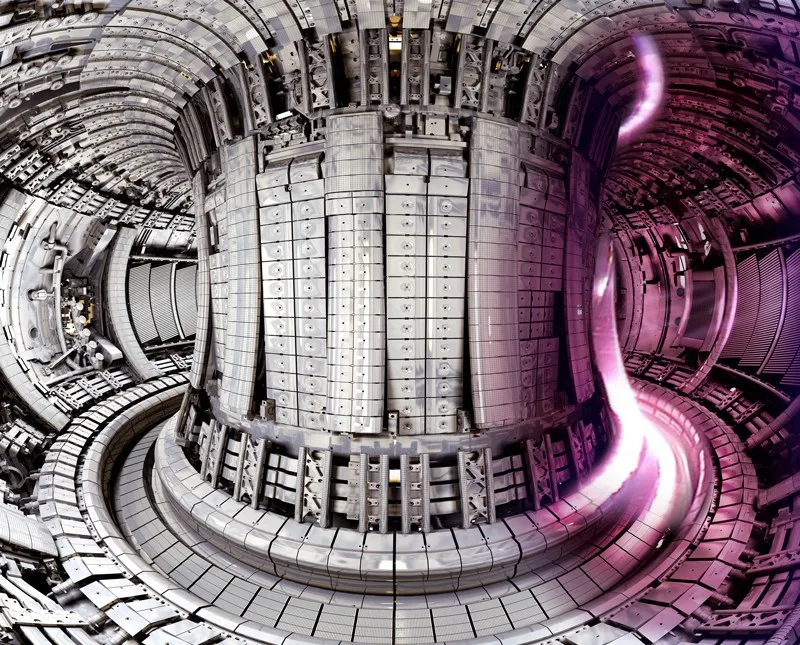
This brings me to a rather practical, albeit unconventional, proposition: e/acc should be recognized as an official religion.
As there are no reasonable ways to stop students and employees from being forced to engage with such obligatory courses, recognizing e/acc as a religion could provide a path for conscientious objection to mandatory sustainability courses—not to avoid education, but to allow a path to those who want to focus on subjects directly relevant to their field. If sustainability courses are made mandatory because they reflect a particular perspective on humanity’s relationship to technology and the environment, then those who prioritize objective, field-specific studies deserve the same respect. This extends beyond students; employees in tech-driven sectors should also have the option to opt out of mandatory sustainability training if it does not contribute directly to their professional work.
Some believe in slowing innovation for sustainability, while others advocate for accelerating it to achieve the same goals. It is important to recognize that this choice should be left to individuals. The idea of imposing one path over the other in an otherwise objective program like computer science seems in alignment with the stereotypes that have been shaped about the lack of plurality in academia. Instead, individuals should have the freedom to align their educational and professional pursuits with their own perspectives on how best to address global challenges, if indeed they choose to engage with such questions at all.
### The right to choose
This suggestion highlights a fundamental issue: education in subjective issues should be about choice, not the enforcement of a singular belief. Whether one believes that the path to sustainability lies in slowing progress or accelerating it, neither perspective should dominate the educational agenda. Both views should be offered as choices, allowing students and employees to decide for themselves which aligns with their values and professional goals. No single belief should override the choices of others, especially in an educational setting that claims to foster intellectual diversity.
Ultimately, the focus is not on formally registering e/acc as a religion, but on ensuring that individuals have the freedom to opt out of mandatory courses that do not align with their professional focus or are antithetical to their personal positions. Until sustainability courses either become non-mandatory or incorporate both accelerationist and decelerationist perspectives, those who find them irrelevant should have the option to avoid them. Intellectual diversity and the freedom to choose one's approach are crucial. Students and employees should have the choice to engage with sustainability in the way they see fit—whether through caution and restraint or through a belief in technological acceleration as a solution.
### Related Articles
- [Forecasting the progression of human civilization on the Kardashev Scale through 2060 with a machine learning approach](https://www.nature.com/articles/s41598-023-38351-y)
- [Is the EU overreaching with new digital regulations?](https://www.economist.com/europe/2022/09/01/is-the-eu-overreaching-with-new-digital-regulations)
- [The role of artificial intelligence in achieving the Sustainable Development Goals](https://www.nature.com/articles/s41467-019-14108-y)
- [The EU according to Draghi – as competitive as needed, as sustainable as possible](https://www.ceps.eu/the-eu-according-to-draghi-as-competitive-as-needed-as-sustainable-as-possible/)
---
# The Bursting AI Bubble
> As the AI bubble might be bursting, there are still many things to look forward to
By Avid Fayaz | 25 August 2024 | https://www.avidfayaz.com/writings/PopCulture/pop-culture-ai-hype-and-what-follows

In 2001, tech stocks of internet companies that promised to revolutionize the digital future soared to unprecedented heights. Investors were convinced that the internet would usher in an era of unlimited growth and prosperity. However, reality turned out quite differently. The bubble burst when many of the companies that were expected to lead this new digital age posted disappointing results, revealing that despite years of multi-million-dollar investments, they had failed to generate any substantial profits.
What followed can be best compared to the story of the Emperor’s new clothes, after the little girl points out that the emperor is naked. Although it had been years without significant measurable growth among digital and technology companies, dot-com companies' valuations continued to soar—until a small burst that, once seen, could no longer be ignored. The bubble burst, and within a few weeks, a profusion of companies with no solid financial or technological grounding were wiped out. Yet, as we can see today, many of the internet-based companies founded during and after the dot-com rush are still standing, eventually delivering on many of the promises made during that era.
In many ways, the AI hype can be compared to the dot-com bubble. With the promise of a new golden age of productivity and innovation, creating growth that could eventually lead to a cycle of self-sustaining growth and productivity. However, the AI hype is more complex, as the promises and issues arise within the confusing nature of how Artificial Intelligence is defined.
Since the dawn of the computer age, the idea of creating hardware and software that could replicate human intelligence has fascinated those in computer science and science fiction. Reality, however, has been different with many AI winters and springs ensuing. Yet, due to the nature of recent AI breakthroughs, there have been many arguments—both inside and outside the field—that an Artificial Super-Intelligence might soon be within reach.
### A Question of Scale
A closer look at these models' inner workings reveals their strengths and weaknesses. At its core, a transformer model, the force behind large language models (LLMs), is trained on large corpora of text, which it tokenizes into smaller parts (mostly single words). The model then learns to identify relationships between these tokens. By doing this on large enough corpora, these models develop an impressive “understanding” of language. As these corpora expanded to include vast data from the internet, the models began demonstrating capabilities that many regard as reasoning.
However, the generative capabilities of these models are still grounded in and bound by the old architectural limitations of transformers. In essence, they generate sentences based on the statistical likelihood of a token being the best fit in a given context.
### To Err is Human
Partly the misassessment of LLMs’ capabilities is perhaps due to the all-too-human error of anthropomorphization—the tendency to assign human traits to inanimate objects, animals, or in this case, software. This was evident in people’s reactions to ELIZA (developed by Joseph Weizenbaum in the 1960s), the very first chatbot that made many who interacted with it believe they were interacting with a sentient computer program.
Some have argued that if the current generative models were looped to continuously repeat and improve themselves, they might accidentally accumulate some form of human-like intelligence. While these arguments cannot be entirely dismissed —since evolution is riddled with accidents— the belief that models trained to produce the next token could somehow overcome their inherent structural limitations is easily dismissible.
For instance, asking ChatGPT or one of its rivals whether 3 is a prime number will yield a confident 'yes,' as it has processed texts affirming this. However, with larger, less familiar prime numbers, the model may start providing incorrect answers due to a lack of specific training data. This occurs because it makes a statistical assessment that a large number is less likely to be prime. Once the model commits to a specific token —whether "yes" or "no"— it will continue its reasoning from that point, presenting an elegant yet entirely incorrect explanation.
This problem is one of the first exercises first-year computer science students learn to solve using the Sieve of Eratosthenes, an ancient algorithm from the 3rd century BCE. While ChatGPT could provide this algorithm in any programming language, as it is readily available on many public repositories included in its training data, it does not apply this logic to ensure its own answers are correct.
Without delving into the philosophical aspects behind the definition of mathematics, insofar as defining logic as the underlying structure for mathematical reasoning, it can be argued that logical reasoning is essential for our subjective attempts to describe the formula for truths and to establish consistent relationships with the laws of thought. A model that is incapable of reasoning to perform the simplest arithmetic and division, despite all the computational resources behind it cannot be regarded as a step closer to an artificial general intelligence that could evolve into a superintelligence.
So while many, if not most, agree that an Artificial General Intelligence would indeed pose a threat to humanity, as it challenges our status as the planet's superior intelligence, models without inherent logical and reasoning capabilities that can’t consistently answer how many "r"s are in "strawberry" are unlikely to present that challenge.
### The Discovery of Fire
The overestimation of LLMs' capabilities and the belief that further scaling would lead to significantly greater advancements have been major drivers of the AI hype. To the extent that at its very peaks the CEO of one of the major AI developers compared it to the discovery of fire. However, setting aside the dreams of AGI and analyzing LLMs solely as a technological leap in language capabilities, we confront the reality that not only has the continuous exponential growth many anticipated not materialized, but many of the major companies developing LLMs are also struggling to monetize them efficiently.
Since the initial release of ChatGPT in November of 2022, the valuation of many companies involved in developing both the hardware and software behind LLMs has skyrocketed, with the valuation of Nvidia, the developer of the GPUs that are used to train the frontier AI language models, going from 400 billion dollars to over 3 trillion dollars within less than 18 months and at its peak supplanting both Apple and Microsoft as the most valuable company in the world.
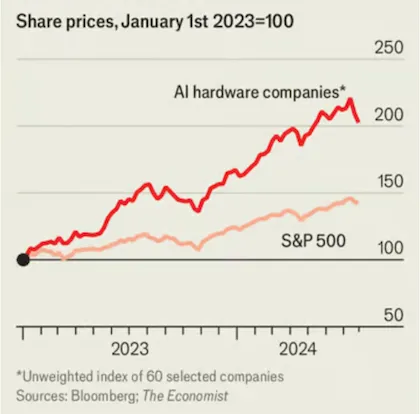
Nvidia's sudden and meteoric rise can be justified in many ways, as it was one of the first companies in the chip industry to explore the uses of GPUs beyond graphics and gaming. GPUs are uniquely suited for performing massive amounts of parallel processing, a core requirement for training and maintaining LLMs. Moreover, Nvidia’s proprietary CUDA platform has become the de facto industry standard for software designed to run on its GPUs, further entrenching its position over its rivals in the AI chips race.
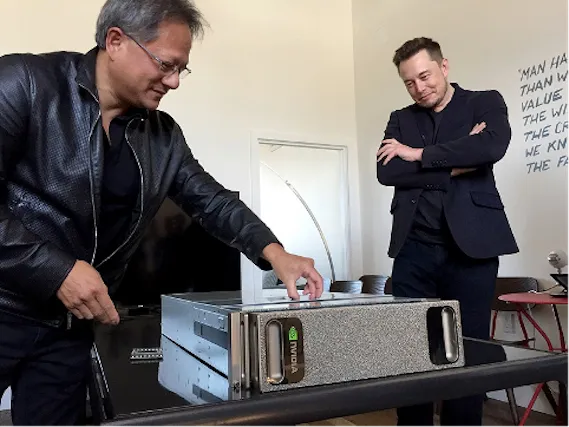
Despite Nvidia’s near-monopolistic hold on the hardware behind the most advanced LLM models, it is unlikely that this dominance can be maintained over the long term. Rivals like AMD are adopting similar modular architectures in their chip designs, and efforts are underway to port software written in CUDA to other platforms like AMD’s ROCm. Additionally, a significant number of startups with strong financial resources, have started designing chips specifically tailored for LLM training and processing, with the goal of leapfrogging the industry giants.
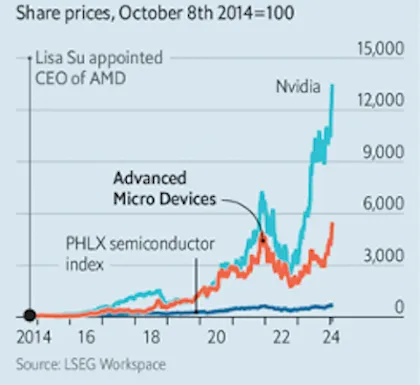
All of this would be of little concern if the demand for more powerful AI chips were expected to continue growing as it has over the past year. Many companies, from tech giants like Google, Amazon, and Microsoft to state-backed firms in Europe and Asia, have pledged to invest billions of dollars in GPU farms and data centers to develop stronger and more capable models. However, several factors could potentially halt the current surge in GPU demand.
The most critical factor is scaling. As mentioned earlier, scaling has been the key driver behind the advancements in LLM capabilities. The issue, however, is that the most advanced models currently available have already consumed all the accessible data for training. While developers like OpenAI and Google are striking deals with media companies to access data behind paywalls, it's becoming apparent that scaling might be reaching its limits. For example, the release of LLaMA 3.1, Meta’s open-source model, demonstrated that the leap from 70 to 405 billion parameters did not produce gains as significant as the jump from 8 to 70 billion parameters on most major benchmarks.

The second factor is the surfeit of AI companies developing and training LLMs. Currently, there are at least 10 companies working on developing frontier large language models, most of which rely on cloud providers for their training compute, with Meta and X AI being notable exceptions. Cloud providers like Microsoft, Google, and Amazon have committed substantial resources to expanding their GPU clusters. However, with advancements in AI capabilities no longer as significant as they were in the past two years, the market is likely to become oversaturated with too many LLM developers offering similar services. And that is without factoring Meta’s open-source strategy further undercutting the market by making high-quality models widely accessible.
Lastly, the disruptions anticipated in the stock market from the AI revolution have yet to translate into significant profits. The rate of monetization and adoption in major industries has fallen short of initial expectations, partially due to concerns over accuracy and security. But also becasue many companies struggling to find or implement constructive use cases of language models in their operations.
As a result, some of the largest AI developers are facing significant financial losses. All these factors lead to the conclusion that it is highly unlikely that demand for GPUs will continue to be in such high volumes, meaning that the massive jumps in stock prices of AI-related companies based on AI-related growth are overhyped and in a bubble.
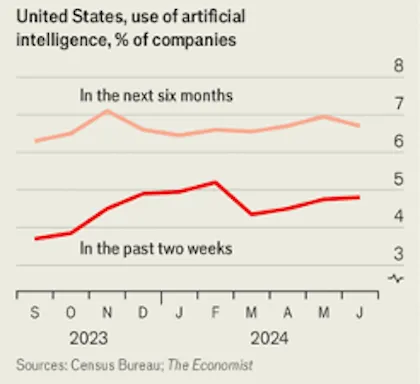
### Strawberry fields forever 🍓
Despite this bubble, it is important not to lose sight of how profound the advancements in LLMs are. For over half a century, computer scientists tried to create machines that could understand and generate human language with fluency and context awareness. The progress made in the past decade, particularly with the advent of LLMs, represents a significant leap forward in this endeavor. These models have transcended earlier limitations, enabling a wide range of applications that were once thought by many in the industry to be in the realm of science fiction.
Already their use cases in entertainment, education, drug discovery, and crystallography have become apparent. In entertainment, LLMs are transforming content creation, generating scripts, stories, and even music. In education, they serve as personalized tutors, capable of adapting to the unique learning styles and needs of students. In drug discovery and crystallography, LLMs are accelerating research by predicting molecular structures and interactions, leading to faster and more efficient development of new therapies. So, as the industry matures, many more use cases will emerge, potentially delivering on the promised AI revolution and transforming numerous sectors in ways that are yet to be conceived.
And still more advanced models with greater multimodal capabilities and improved reasoning abilities are likely in the pipeline, which could push the boundaries of what LLMs can achieve even further. These models could integrate text, images, audio, and video, developing a more holistic representation of the world. So as we continue to refine and develop these technologies, their impact on society will be profound, extending far beyond what can currently be speculated.
It is therefore, not unjustified to compare the AI hype to the dotcom bubble, as both are characterized by significant overestimation of short-term gains while underestimating the long-term potential. Once again, markets are in a state of overexcitement about a technology that will undoubtedly play a significant role in our lives, yet they are miscalculating how quickly these gains will become evident in people's daily lives.
So, when at some point this bubble bursts, it is important to remember that the concepts and ideas upon which it was created are on a solid grounding and, with time, will eventually materialize.
### Related Articles
- [The Llama 3 Herd of Models](https://arxiv.org/abs/2407.21783)
- [AI models collapse when trained on recursively generated data](https://www.nature.com/articles/s41586-024-07566-y)
- [A Sentence is Worth a Thousand Pictures](https://arxiv.org/pdf/2308.00109)
- [FT: Elliott says Nvidia is in a 'bubble' and AI is 'overhyped'](https://www.ft.com/content/24a12be1-a973-4efe-ab4f-b981aee0cd0b)
- [The Economist: What happened to the artificial-intelligence revolution?](https://www.economist.com/finance-and-economics/2024/07/02/what-happened-to-the-artificial-intelligence-revolution)
- [Scaling deep learning for materials discovery](https://www.nature.com/articles/s41586-023-06735-9)
- [AlphaFold predictions are valuable hypotheses and accelerate but do not replace experimental structure determination](https://www.nature.com/articles/s41592-023-02087-4)
- [The future of learning: How AI is revolutionizing education 4.0](https://www.weforum.org/agenda/2024/04/future-learning-ai-revolutionizing-education-4-0/)